

 By admin
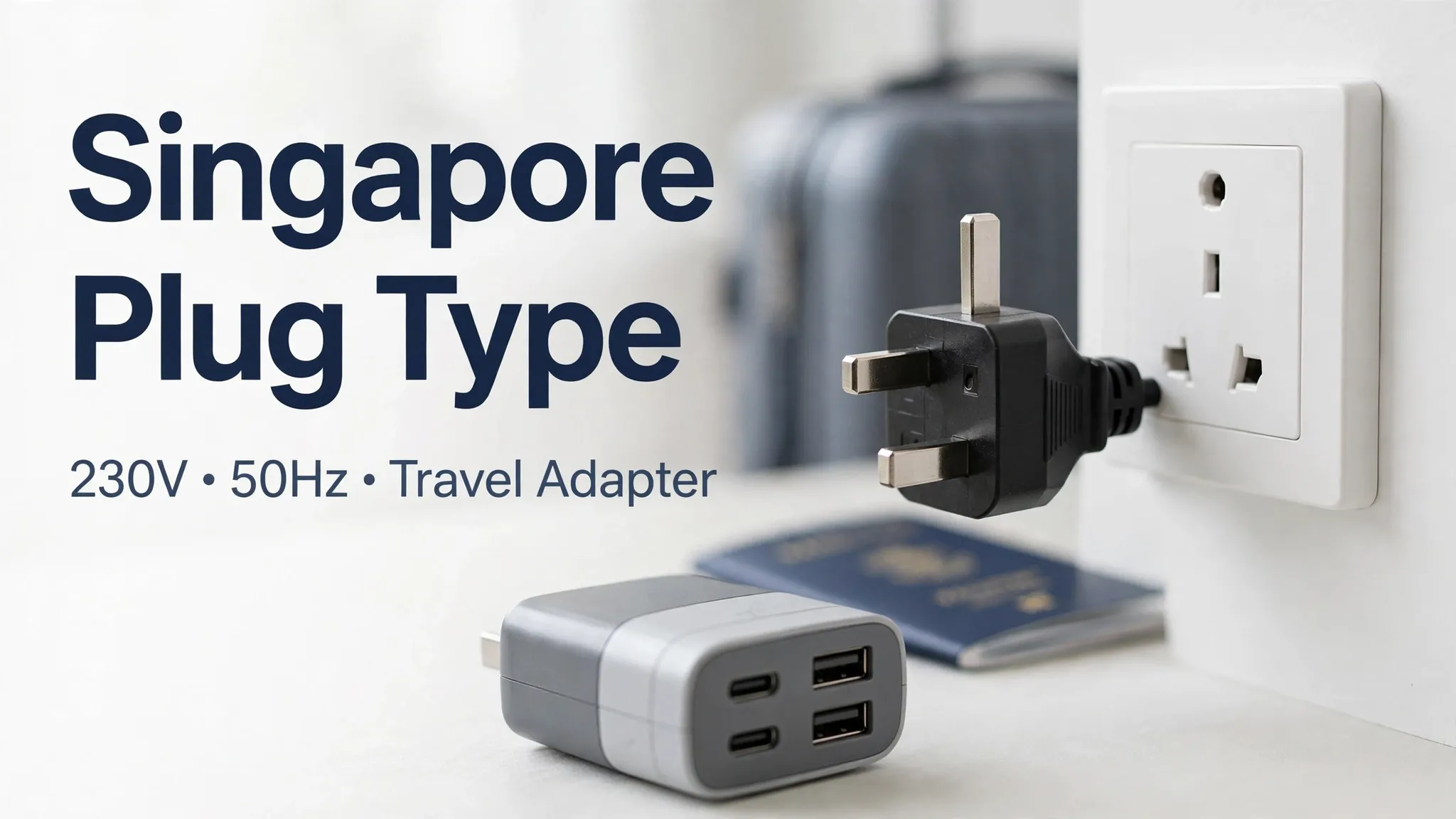
Singapore primarily uses Type G power plugs, the same three-pin plug design commonly found in the UK. The standard electricity supply is 230V at 50Hz, so most visitors need to check two things before plugging in their devices: the shape of the plug and its voltage rating. Type G sockets have three rectangular pins, including an earthing pin for safety. If you’re travelling to Singapore, moving into an HDB flat or staying in a hotel, knowing the local plug type can save you from charging problems and unsuitable adapters.
TL;DR: Singapore Plug Type at a Glance
Singapore mainly uses Type G plugs with three rectangular pins. The standard electricity supply is 230V and 50Hz. UK and Malaysia plugs are generally compatible, while visitors from the US, India, Europe and Australia usually need an adapter. Check your device’s input voltage before connecting it.
| Electrical specification | Singapore standard |
|---|---|
| Main plug type | Type G |
| Voltage | 230V |
| Frequency | 50Hz |
| Pin design | Three rectangular pins |
| Common plug standard | BS 1363 |
What Plug Type Is Used in Singapore?
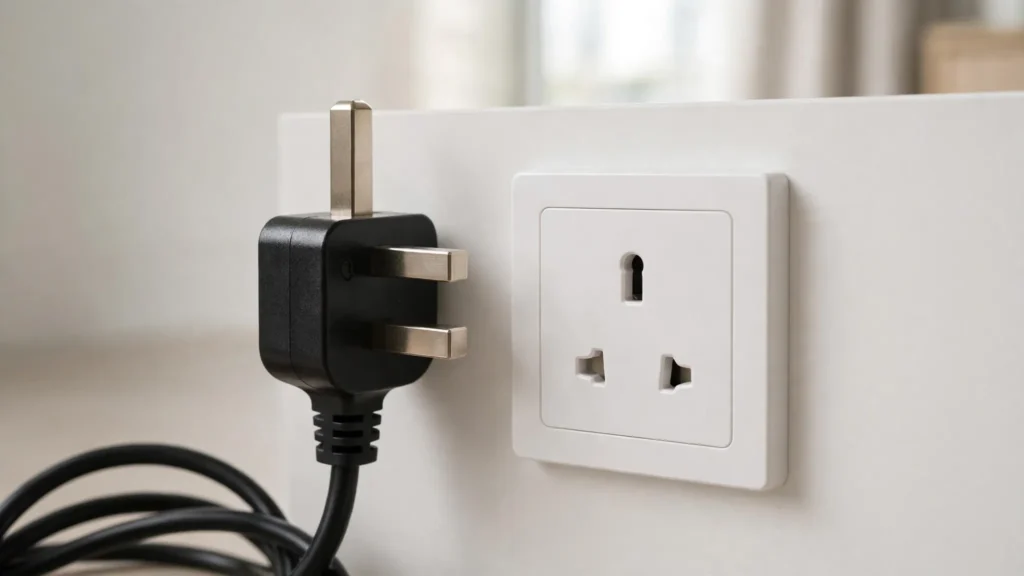
The most common Singapore power plug is Type G, a British-style electrical plug with three rectangular pins arranged in a triangular pattern. The longer top pin is the earthing pin, while the two lower pins carry the live and neutral connections. This design is widely used in homes, hotels, offices and commercial buildings.
You’ll commonly see Type G socket outlets in HDB flats and condominiums, although the number and arrangement of sockets can differ between properties. The plug is associated with the BS 1363 standard and is commonly rated at 13 amps.
If your charger already has a compatible three-rectangular-pin plug, it will generally fit a standard Type G socket in Singapore. But a plug that fits physically still needs to be suitable for the local voltage and electrical rating.
Singapore Voltage and Frequency
Singapore’s standard electricity supply is 230V at 50Hz. Voltage describes the electrical pressure supplied to a device, while frequency refers to how often the alternating current changes direction each second. Both details matter when checking whether an appliance can operate safely.
The UK and Malaysia use similar nominal electrical standards. The US and Japan generally use lower voltage, so visitors carrying appliances from those countries should check the product label before connecting them.
| Country | Common voltage | Frequency |
|---|---|---|
| Singapore | 230V | 50Hz |
| UK | 230V | 50Hz |
| Malaysia | 230V | 50Hz |
| USA | 120V | 60Hz |
| India | 230V | 50Hz |
| Australia | 230V | 50Hz |
| Japan | 100V | 50/60Hz |
These are general nominal supply standards. Actual supply conditions and appliance requirements can vary.
Check the label marked INPUT on your charger or appliance. If it says 100–240V, 50/60Hz, it is designed to work across that voltage range. A device marked only for 110–120V needs extra care before use in Singapore.
Do You Need a Travel Adapter for Singapore?
You need a travel adapter if your device has a plug that does not fit a Singapore Type G socket. The adapter changes the plug’s physical shape so it can connect to the wall socket. It does not change the electricity voltage.
Travellers from the UK, Malaysia and Hong Kong can generally use compatible Type G plugs without an adapter. Visitors from the US, India, Australia and most European countries will usually need one, although the exact requirement depends on the plug fitted to each device.
| Country | Common plug type | Singapore adapter needed? |
|---|---|---|
| UK | G | No, generally |
| Malaysia | G | No, generally |
| Hong Kong | G | No, generally |
| USA | A/B | Yes |
| India | C/D/M | Yes, generally |
| Australia | I | Yes |
| Germany | C/F | Yes |
| France | C/E | Yes |
A universal travel adapter can be handy if you visit several countries. Choose one that clearly supports Type G sockets and has a suitable electrical rating. Don’t assume every small travel adapter can handle high-power appliances.
Singapore Plug Types: Type G, Type C and Type M
Although Type G is the main plug type visitors should know, Singapore recognises other mains plug designs for specific uses. They are not interchangeable, and using the wrong plug or an unsuitable conversion adapter can create a safety risk.
| Plug type | Pin design | Typical application |
|---|---|---|
| Type G | Three rectangular pins | Most household appliances |
| Type M | Three round pins | Certain high-power appliances, such as air-conditioners |
| Type C | Two round pins | Certain low-power, double-insulated appliances |
Type G is the familiar 13A fused plug used for most household appliances. Type M is a 15A three-round-pin plug, generally used for energy-intensive equipment that needs more current. Its socket installation should be handled by a qualified electrical worker.
Type C is a 2.5A two-round-pin plug used for certain low-power appliances with suitable internal insulation. It should be connected using an appropriate fused adaptor. Never force a two-pin plug into a three-pin socket, and don’t assume a European Schuko plug is suitable just because its pins are round.
Will Your Phone, Laptop and Appliances Work in Singapore?
Most modern phone and laptop chargers work in Singapore if their input rating includes 230V and 50Hz. Many are marked 100–240V, 50/60Hz, which means they can accept the local electricity supply. You may only need a Type G travel adapter to make the plug fit.
Hair dryers, straighteners and travel irons need more attention. Some are designed for one voltage only, and high-wattage appliances can place extra demands on a travel adapter. Check the rating printed on the appliance itself, not just the charging cable.
| Device | What to check | Requirement |
|---|---|---|
| Phone charger | 100–240V input | Adapter if plug shape differs |
| Laptop charger | Voltage and frequency | Adapter if needed |
| Camera charger | Input rating | Depends on model |
| Hair dryer | Voltage and wattage | May need a converter |
| Electric shaver | Input specifications | Depends on model |
| Travel iron | Voltage and power rating | Check compatibility |
A charger labelled 110V only should not be plugged directly into a 230V socket. If the input details are unclear, check the manufacturer’s instructions before using it.
Travel Adapter vs Voltage Converter: What’s the Difference?
A travel adapter changes the plug shape so it can fit a different socket. A voltage converter changes the electrical voltage supplied to a device. They do two different jobs.
| Feature | Travel adapter | Voltage converter |
|---|---|---|
| Changes plug shape | Yes | Not necessarily |
| Changes voltage | No | Yes |
| Dual-voltage charger | Usually sufficient | Usually unnecessary |
| 110V-only device | Not enough alone | Correctly rated converter needed |
For example, a US phone charger marked 100–240V usually needs only a suitable Type G adapter. A 110V-only hair appliance may need a voltage converter rated for its wattage — and some high-power devices are better replaced with a model designed for 230V.
Where to Buy a Travel Adapter in Singapore and How Much Does It Cost?
You can look for travel adapters at Changi Airport retail shops, electronics stores, shopping malls, neighbourhood homeware shops and online retailers serving Singapore. Airport shops can be convenient if you forgot to pack one, while shopping around may give you more choices.
Prices depend on the brand, charging ports and power rating. Current Changi Airport retail listings show simple travel adapters around S$18–S$20, while some universal and USB charging models cost more.
| Adapter category | Main features | Indicative price in Singapore |
|---|---|---|
| Basic travel adapter | Single plug conversion | Around S$18–S$20 |
| Universal travel adapter | Supports several plug formats | Around S$32–S$40 and above |
| USB travel adapter | USB charging ports | Around S$30–S$50 and above |
| Multi-port or high-wattage adapter | Multiple USB-C/USB-A ports | Around S$60–S$100 and above |
Prices are indicative examples from Changi Airport retail listings and may change with promotions, stock and product specifications. Check the current price before buying.
Don’t choose an adapter only because it is cheap or labelled “universal”. Check that it supports the plug you need, has an appropriate power rating and is suitable for the appliance you plan to connect.
Electrical Plug Safety Tips in Singapore
A suitable plug and adapter matter for electrical safety, not just convenience. Use a correctly rated Type G adapter, especially when connecting appliances with metal bodies or higher power requirements. Avoid damaged plugs, loose socket outlets and adapters that feel hot during use.
Singapore’s Consumer Product Safety Office (CPSO) advises consumers to use appropriate mains plugs. The 13A Type G and 15A Type M plugs are controlled products and must carry the SAFETY Mark. This mark has a unique registration number that can be checked against the product details. For electrical installation work, use a qualified Licensed Electrical Worker (LEW).
A few safety checks before plugging in:
- Check the plug, cable and adapter for cracks, loose parts or damage.
- Never force an incompatible plug into a socket outlet.
- Use a suitable fused adaptor for compatible two-pin Type C appliances.
- Avoid using small travel adapters with appliances that exceed their power rating.
- Check the SAFETY Mark on regulated products sold in Singapore.
- Get a qualified electrical worker to inspect faulty sockets or electrical installations.
Frequently Asked Questions About Singapore Plug Type
1. What plug type is used in Singapore?
Singapore mainly uses Type G plugs. They have three rectangular pins arranged in a triangular pattern, with an earthing pin at the top.
2. Is Singapore plug the same as the UK?
Yes. Both commonly use Type G plugs with three rectangular pins. Compatible UK plugs generally fit Singapore Type G sockets.
3. What voltage does Singapore use?
Singapore’s standard electricity supply is 230V at 50Hz. Check your appliance’s input label to confirm it supports these electrical specifications.
4. Do I need a travel adapter for Singapore?
You generally need one if your device has a plug other than Type G. Visitors from the US, India and Australia usually need an adapter.
5. Can I use my US phone charger in Singapore?
Usually, yes, if its input label states 100–240V and 50/60Hz. You’ll still need a Type G adapter for the socket.
6. Do Indian plugs work in Singapore?
Not generally. India commonly uses Type C, D and M plugs, while Singapore mainly uses Type G. Carry a suitable travel adapter.
Conclusion
Singapore mainly uses Type G power plugs, with a standard electricity supply of 230V and 50Hz. Bring a suitable adapter if your plug doesn’t match the local socket, and check your device’s input rating before connecting it. A little preparation can prevent charging issues and electrical mishaps during your stay.
[…] Places to Eat in 2026 Singapore Hawker Centre Prices: How Much Does Food Cost in 2026? Singapore Plug Type: Power Sockets, Voltage & Travel Adapter Guide 15 Singapore Famous Street Food You Must Try Singapore Tourist SIM Card: Best SIM Cards, […]