

 By admin
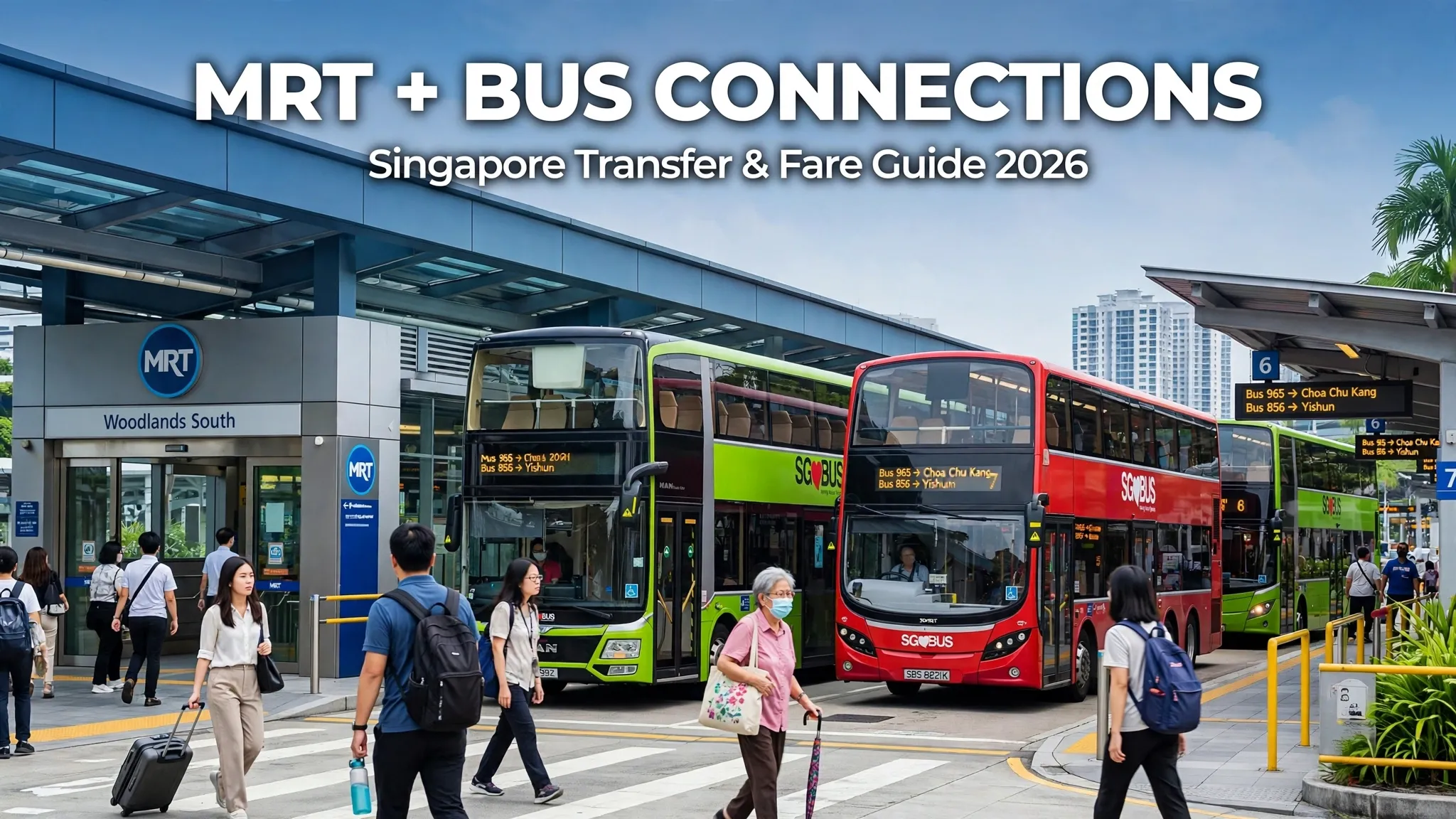
Singapore’s public transport network connects MRT trains, LRT services and public buses, making it easier to travel between residential estates, town centres and popular destinations. MRT Bus Connections are available through bus interchanges, Integrated Transport Hubs (ITHs) and public bus stops located near MRT stations. You can take a train for part of your journey and continue by bus using an eligible payment method. But knowing where to transfer, which bus to board and how the fare system works can save time and prevent unexpected charges. Here’s what commuters should know before travelling.
TL;DR: MRT Bus Connections at a Glance
Singapore MRT and bus services connect through nearby bus stops and integrated transport hubs. Eligible commuters can transfer between trains and buses using the same accepted payment card or device. The transfer window is generally 45 minutes between rail and bus services. Fares follow a distance-based system, so an eligible connected journey is charged according to the total travel distance rather than each section separately.
How MRT Bus Connections Work in Singapore
Singapore’s public transport network brings together MRT, LRT and public bus services. MRT stations often have bus stops nearby, while selected locations have a bus interchange connected directly to the train station.
Commuters can use these connections for different parts of a journey. For example, a feeder bus may take someone from a residential estate to an MRT station. They can then continue by train before taking another bus closer to their destination.
What Is an Integrated Transport Hub (ITH)?
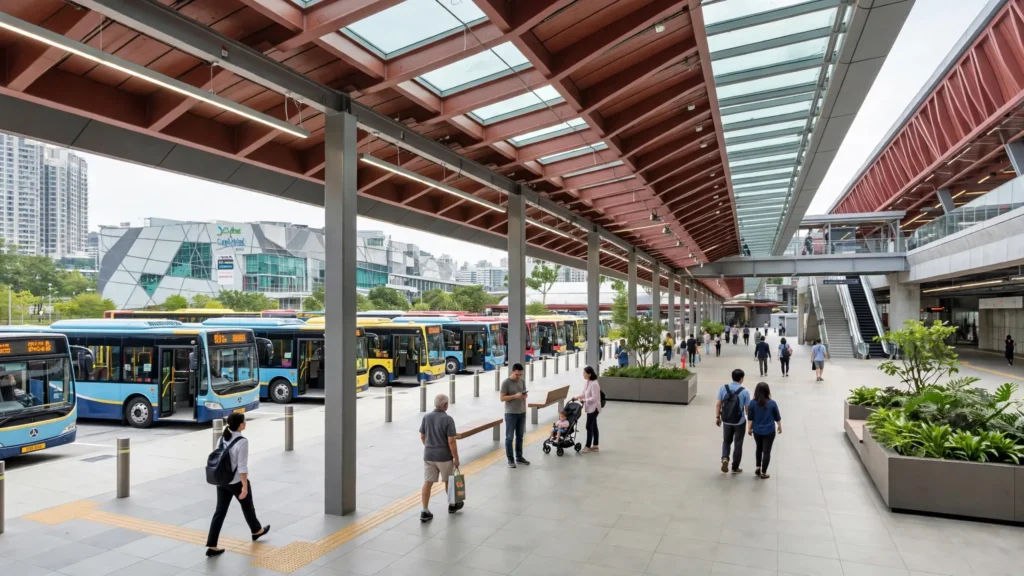
An Integrated Transport Hub is an air-conditioned bus interchange connected to an MRT station or located within the same transport development. It makes changing between buses and trains more convenient, especially during rainy weather.
Ang Mo Kio, Bedok, Woodlands and Serangoon are examples of areas with integrated bus interchanges. Not every MRT station has an ITH, though. Some stations are served by ordinary public bus stops along nearby roads.
How to Transfer from MRT to Bus in Singapore
Changing from an MRT train to a public bus is usually straightforward. The main thing is to check the correct station exit and bus stop before leaving the station.
Steps for MRT-to-Bus Transfers
- Reach your MRT station: Take the train to the station closest to your intended bus connection.
- Check the station signs: Look for exit directions and signs pointing towards the bus interchange or nearby bus stops.
- Find the correct bus stop: Check the stop location and bus stop code, especially if several stops are nearby.
- Confirm the bus service number: Make sure the service goes towards your destination. Check its route before boarding.
- Tap in when boarding: Use an accepted travel card or contactless payment method on the card reader.
- Tap out when alighting: Remember to tap the same card or device when leaving the bus.
And don’t assume every bus stop is inside the MRT station. Some are across the road or a short walk from the station exit. Check the walking route before leaving the station.
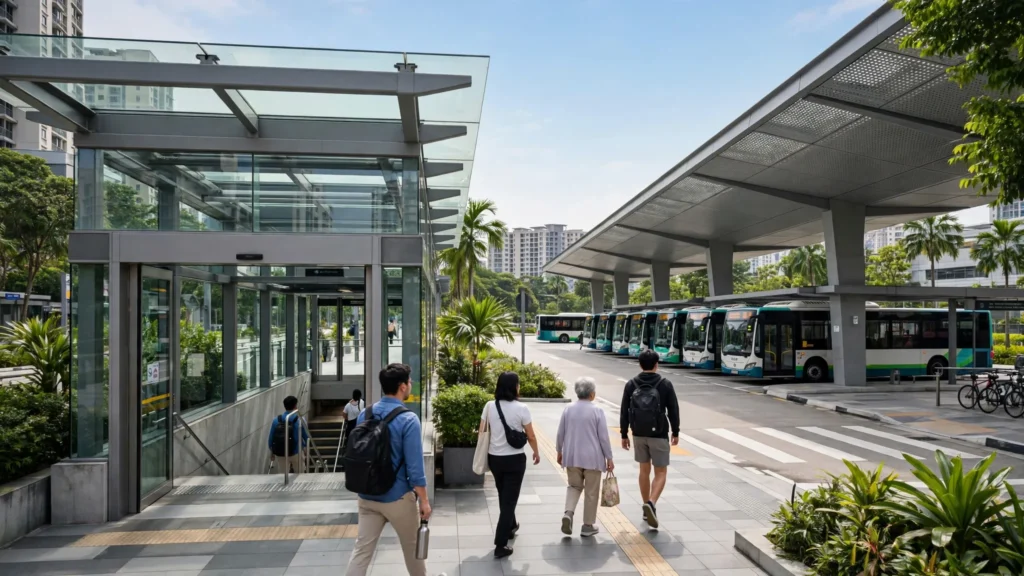
How to Transfer from Bus to MRT
A bus-to-MRT transfer works in the same way, but you’ll need to locate the correct station entrance after getting off the bus.
First, alight at the bus stop serving your MRT station or interchange. Check the station signs to find the entrance and the train line you need. At interchange stations, confirm the platform and train direction before boarding.
Use the same eligible payment card or device for the connected journey. Tap in at the MRT fare gate and tap out when you reach your destination. The applicable transfer time limit and fare conditions still apply.
If the bus stop is not directly beside the station, allow extra walking time. A few minutes can make a difference when you’re trying to meet the transfer window.
Singapore MRT Stations with Integrated Bus Interchanges
Several MRT stations across Singapore have bus interchanges that make changing between train and bus services easier. Here are selected examples commuters may find useful.
| MRT station / area | Bus connection |
|---|---|
| Ang Mo Kio | Integrated bus interchange |
| Bedok | Integrated bus interchange |
| Boon Lay | Integrated bus interchange |
| Bukit Panjang | Integrated bus interchange |
| Clementi | Integrated bus interchange |
| Serangoon | Integrated bus interchange |
| Woodlands | Integrated bus interchange |
| Sengkang | Integrated bus interchange |
| Woodleigh | Integrated bus interchange |
| Punggol Coast | Integrated bus interchange |
These are selected examples, not a complete directory of every bus interchange in Singapore. Check the station information before travelling, as facilities and service arrangements can change.
What If Your MRT Station Does Not Have an Integrated Bus Interchange?
You can still connect to public buses from stations without an ITH. Look for nearby bus stops and check the station exit that gives you the shortest walking route. Bus stop codes are useful when several stops serve the same MRT station.
Check the bus service number and estimated arrival time before leaving the station. This is particularly helpful if you’re unfamiliar with the area or travelling during peak hours.
Singapore MRT and Bus Transfer Rules and Time Limits
Singapore uses a distance-based fare system for eligible connected public transport journeys. But a transfer must meet the applicable time and service conditions to qualify for the combined fare calculation.
How Much Time Do You Have to Transfer?
| Transfer type | Time limit |
|---|---|
| Rail to bus | 45 minutes |
| Bus to rail | 45 minutes |
| Bus to bus | 45 minutes |
| Rail to rail at different stations | 15 minutes |
| Maximum transfers per journey | 5 |
| Maximum journey duration | 2 hours |
For rail-to-bus and bus-to-bus transfers, the next service generally needs to be boarded within 45 minutes of alighting from the previous service. Rail-to-rail transfers between different stations have a 15-minute limit.
A connected journey can include up to five transfers, and the time between the first and last boarding must not exceed two hours. The current bus service must also be different from the preceding bus service.
You generally cannot exit and re-enter the same MRT station as part of a valid transfer. Specific interchange exceptions apply at Bukit Panjang, Newton and Tampines when changing between train lines. Follow the current fare rules if your journey involves these stations.
Singapore MRT and Bus Fares: How Much Does a Connected Journey Cost?
Singapore MRT and basic bus fares are calculated according to travel distance. For eligible transfers, the system considers the total journey distance instead of charging a separate full fare for every connected section.
Adult card fares for basic bus and train services start at S$1.28 for journeys up to 3.2 km. The following table shows selected distance bands.
Adult Card Fare Reference
| Travel distance | Adult card fare |
|---|---|
| Up to 3.2 km | S$1.28 |
| 3.3–4.2 km | S$1.38 |
| 4.3–5.2 km | S$1.49 |
| 5.3–6.2 km | S$1.59 |
| 6.3–7.2 km | S$1.68 |
| 7.3–8.2 km | S$1.75 |
These are basic adult card fare references, not fixed prices for every MRT-to-bus combination. Your actual fare depends on the total distance and whether the transfer meets the fare conditions. Cash fares, concessionary fares and express bus fares may differ.
Accepted payment options include eligible EZ-Link and SimplyGo cards, as well as contactless bank cards. Use the same card or device when tapping in and out throughout the journey. Mixing a physical card with a mobile wallet linked to the same bank card may be treated as using two different payment methods.
Feeder Bus vs Trunk Bus: What’s the Difference?
Feeder and trunk buses serve different travel needs within Singapore’s public bus network.
| Feature | Feeder bus | Trunk bus |
|---|---|---|
| Main purpose | Local connections | Longer journeys |
| Coverage | Residential areas | Multiple towns and destinations |
| Typical use | Home to MRT station | Connecting different areas |
| Journey type | Shorter local trips | Longer bus routes |
Feeder bus services usually connect residential neighbourhoods with nearby MRT stations or town centres. Trunk bus services cover longer routes and link different parts of Singapore.
A commuter may use a feeder bus to reach an MRT station in the morning, then take a trunk bus for another part of the journey later in the day.
How to Find MRT and Bus Connections in Singapore
Checking your route before leaving home can save time, especially when your journey involves more than one transfer. Singapore has several public transport tools that show route and service information.
Useful Journey Planning Tools
| Platform | What you can check |
|---|---|
| MyTransport.SG | Bus arrivals, routes and journey information |
| SimplyGo | Fare information and travel details |
| LTA Journey Planner | Public transport journey options |
Enter your starting point and destination to compare MRT and bus combinations. Check the estimated journey time, walking distance and bus arrival timings before setting off.
And if you’re travelling during a service disruption, check the latest travel advisories. A bus route or train service may have a temporary change that affects your usual connection.
Common MRT and Bus Transfer Mistakes to Avoid
A small mistake can cause delays or an unexpected fare. Check the bus service number before boarding, and make sure you’re waiting at the correct bus stop. Don’t ignore the transfer time limit or forget to tap in and out. Also, check bus arrival information rather than assuming the next service will arrive immediately.
Frequently Asked Questions About MRT Bus Connections
1. Can I transfer from MRT to bus using the same EZ-Link card?
Yes. You can use the same eligible EZ-Link card for an MRT-to-bus transfer. Tap in and out correctly, and follow the applicable transfer time and fare conditions.
2. How long can I take to transfer from MRT to bus in Singapore?
The general transfer window is 45 minutes between a train station and a bus service. You must meet the relevant transfer conditions for the connected fare to apply.
3. Do I pay separately when transferring from MRT to bus?
Eligible connected journeys use distance-based fare calculation. The fare is based on the total journey distance rather than charging a separate full fare for each section.
4. Which MRT stations have integrated bus interchanges?
Selected examples include Ang Mo Kio, Bedok, Boon Lay, Bukit Panjang, Clementi, Serangoon, Woodlands, Sengkang, Woodleigh and Punggol Coast.
5. How can I find connecting bus services near an MRT station?
Check MyTransport.SG for bus routes and arrival timings. You can also use journey planning tools to compare available MRT and bus combinations.
Conclusion
MRT Bus Connections make travelling around Singapore easier by linking train stations with bus interchanges and nearby stops. Check your station exit, bus service, transfer window and fare conditions before travelling. A little planning can make daily commutes and trips across Singapore less stressful.
[…] MRT Barrier Free Access Singapore: Wheelchair Facilities, Lifts & Accessible Routes (2026) MRT Bus Connections Singapore: Transfers, Fares & Travel Guide (2026) MRT Accessibility Guide Singapore: Wheelchair Access, Lifts and Facilities MRT Bicycle […]