

 By admin

Singapore’s MRT stations have different exits leading to nearby streets, shopping malls, offices and tourist attractions. Choosing the correct exit can save you extra walking time, especially when you are visiting an unfamiliar area or meeting someone at a specific location. But how do you know which exit to use? A station may have several exit numbers or letters, and each one can lead to a different part of the neighbourhood. This Singapore MRT Exit Guide explains how to read exit directories, understand locality maps and follow station signs, with examples from popular MRT stations across the island.
TL;DR: Singapore MRT Exit Guide
To find the correct MRT exit in Singapore, check the station’s exit directory or locality map before passing through the fare gantry. Match your destination with its exit number or letter, then follow the directional signs. Check official LTA or SMRT station information for updated exit and accessibility details.
How Singapore MRT Station Exits Work
Singapore MRT stations have exits that connect passengers to different streets, buildings, shopping centres and public facilities. Depending on the station, exits may use numbers, letters or a combination of signage styles. The layout is not identical across the network, so it is better to check the directory at your station rather than assume every MRT exit follows the same pattern.
Understanding MRT Exit Numbers and Letters
An MRT exit number or letter identifies a particular way out of the station. For example, one exit may lead towards a shopping mall, while another connects to a nearby road or bus stop. Newer stations may use numbered exit labels, while some older stations have alphabetical labels.
Look at the exit signs and station directory to match the label with your destination. At an MRT interchange, check the information for the correct station and line, as the station layout can have several connecting areas.
What Is an MRT Exit Directory?
An MRT station exit directory is a sign or map showing the available exits and nearby places. It may list streets, shopping malls, landmarks, bus stops and other public facilities.
These directories are useful when you are visiting an unfamiliar station. They help you identify which exit is closest to your destination before you leave the station. Directional signs around the concourse also guide you towards the correct exit.

How to Find the Correct MRT Exit in Singapore
Finding the right MRT exit is easier when you check your destination before leaving the station. A few minutes spent reading the signs can save you from walking in the wrong direction or returning to the station entrance.
Check Your Destination Before Leaving the Station
Start by identifying the exact building, attraction or street you want to reach. If you are going to a shopping mall, use its full name rather than relying only on the surrounding area. Also confirm that you are at the correct MRT station, particularly if several stations serve the same district.
Read the Station Locality Map
Look for the locality map near the concourse or exit directory. It usually shows the station’s surroundings, nearby roads, buildings and exit locations. Find the “You Are Here” marker first, then check which exit is closest to your destination.
Remember that the nearest exit on a map may not always provide the shortest walking route. Roads, crossings and pedestrian paths can affect the actual journey.
Follow Directional Signs Before Tapping Out
Read the exit information before passing through the fare gantry. Follow the signs for your selected exit and check the label again as you approach it. If you are unsure, stop at the directory and confirm the direction rather than choosing an exit at random.
Table 1: How to Find the Correct MRT Exit
| Step | Action |
|---|---|
| 1 | Identify your destination |
| 2 | Check the exit directory |
| 3 | Read the locality map |
| 4 | Confirm the exit number or letter |
| 5 | Follow directional signs |
Singapore MRT Exit Guide for Popular Stations
Some Singapore MRT stations are connected to major shopping centres, attractions and tourist areas. Knowing the nearby destinations can help you decide which station information to check before leaving the train.
The examples below show popular places around each station. They are destination references, not a list of confirmed exit numbers. Always check the station’s current exit directory for the exact exit serving your destination.
Orchard MRT Station
Orchard MRT Station is in Singapore’s well-known shopping district. Nearby destinations include ION Orchard, Wisma Atria and the Orchard Road shopping area. If you are visiting a particular shop or building, check its name on the station directory instead of assuming the closest-looking exit is the right one.
Bugis MRT Station
Bugis MRT Station serves a busy area with shopping, food and heritage attractions. Bugis Junction and Bugis Street are popular destinations nearby. Check the locality map to see which exit is most suitable for the part of the area you plan to visit.
Bayfront MRT Station
Bayfront MRT Station provides access to the Marina Bay area. Popular destinations include Marina Bay Sands and Gardens by the Bay. These attractions cover large areas, so check the exact entrance or building you want to reach before choosing an exit.
HarbourFront MRT Station
HarbourFront MRT Station is connected to VivoCity and HarbourFront Centre. It is also a common starting point for visitors travelling towards Sentosa. Check the signs for your intended destination, as the route to the shopping centre may differ from the route towards Sentosa access.
Chinatown MRT Station
Chinatown MRT Station serves the heritage district, including Pagoda Street and nearby food and shopping areas. The locality map can help you identify the streets and landmarks around the station, particularly if you are visiting the area for the first time.
Changi Airport MRT Station
Changi Airport MRT Station serves the airport area, with access to the airport terminals. Jewel Changi Airport is another popular destination for visitors. Follow airport wayfinding signs and check the directions for your intended terminal or Jewel rather than relying on a general station exit label.
Table 2: Popular MRT Stations and Nearby Destinations
| MRT Station | Nearby destination |
|---|---|
| Orchard | ION Orchard |
| Bugis | Bugis Street |
| Bayfront | Gardens by the Bay |
| HarbourFront | VivoCity |
| Chinatown | Pagoda Street |
| Changi Airport | Jewel Changi Airport |
How to Read a Singapore MRT Exit Map
A Singapore MRT exit map shows the station’s layout and the places around it. It can help you understand where each exit leads before you leave the station.
Understand Exit Markers and Locality Maps
Start with the “You Are Here” marker to identify your current position. Then look for exit labels, street names and nearby buildings. Some maps also show pedestrian connections, underpasses and entrances to shopping centres. Check the direction of the map carefully, as the displayed layout may not match the direction you are facing.
Check Walking Routes and Nearby Bus Stops
A locality map may show nearby bus stops and their five-digit bus stop codes. These details are useful if you plan to continue your journey by bus. Check the pedestrian route as well as the estimated walking distance. A nearby building may require you to cross a road or use a designated walkway, so the shortest distance on a map may not be the easiest route on foot.
MRT Exit Guide for Tourists and Wheelchair Users
Station exits are not all designed in the same way. If you are travelling with a wheelchair, pram, large luggage or young children, check the available facilities before starting your journey.
Finding Barrier-Free MRT Access
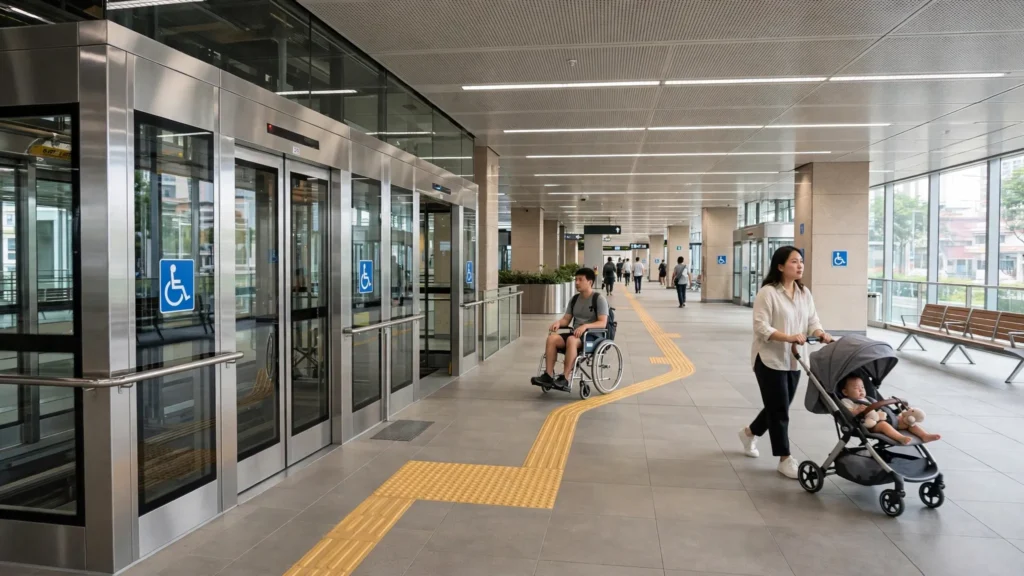
Look for lift symbols and barrier-free access information on the station map. Check whether the lift connects the platform, concourse and street level along your intended route. Some stations may have lifts at selected exits rather than every exit. Station-specific accessibility information is especially useful if you need a step-free route.
Using MRT Exits with Luggage or Children
Lifts are generally more suitable than stairs when you have heavy luggage or a pram. Escalators may also be available, but check the station signs before choosing a route. Allow extra time at busy stations and look for the most direct accessible path. If you are unsure, ask station staff for help.
Common MRT Exit Mistakes to Avoid
A wrong exit can add unnecessary walking time, especially around large shopping districts or busy interchanges. Avoid choosing an exit simply because it looks closest. Check the destination name, read the locality map and confirm the exit label before leaving. Also, do not rely on old screenshots or assume every exit has lift access. Station layouts and facilities can differ, so use current station information when planning your journey.
Table 3: Common MRT Exit Mistakes
| Mistake | Better approach |
|---|---|
| Choosing any nearby exit | Check your destination |
| Ignoring exit directories | Read locality maps |
| Using outdated maps | Check official information |
| Assuming lift access | Verify accessibility |
Frequently Asked Questions About Singapore MRT Exits
How do I find the correct MRT exit in Singapore?
Check the station’s exit directory and match your destination with the corresponding exit number or letter. Follow the directional signs before passing through the fare gantry.
Where can I find Singapore MRT exit maps?
You can check station information and maps from official LTA and SMRT resources. Exit directories and locality maps are also displayed inside MRT stations.
Do all Singapore MRT stations have multiple exits?
No. Exit arrangements vary between stations. Some have several exits serving different streets or buildings, while others have fewer exit points.
How do I find the nearest MRT exit to a shopping mall?
Search for the mall’s name on the station locality map or exit directory. Check the listed exit and follow the signs. For large malls, confirm the entrance you want to reach.
Are Singapore MRT stations wheelchair accessible?
Many stations provide barrier-free access, but lift availability and accessible routes vary. Check the station-specific accessibility information before travelling, especially if you need a step-free route.
Conclusion
Choosing the correct MRT exit guide in Singapore can make a journey easier and reduce unnecessary walking. Check the exit directory, read the locality map and follow the directional signs before leaving the station. If you need lift or wheelchair access, confirm the facilities at your chosen station using current official information.
[…] Pick Up Points in Singapore: Locations, Taxi Stands & Grab Guide (2026) Singapore MRT Exit Guide: Maps, Station Exits & Nearby Places MRT Entrance Guide Singapore: How to Find the Right Station Entrance (2026) MRT Barrier Free […]