

 By admin
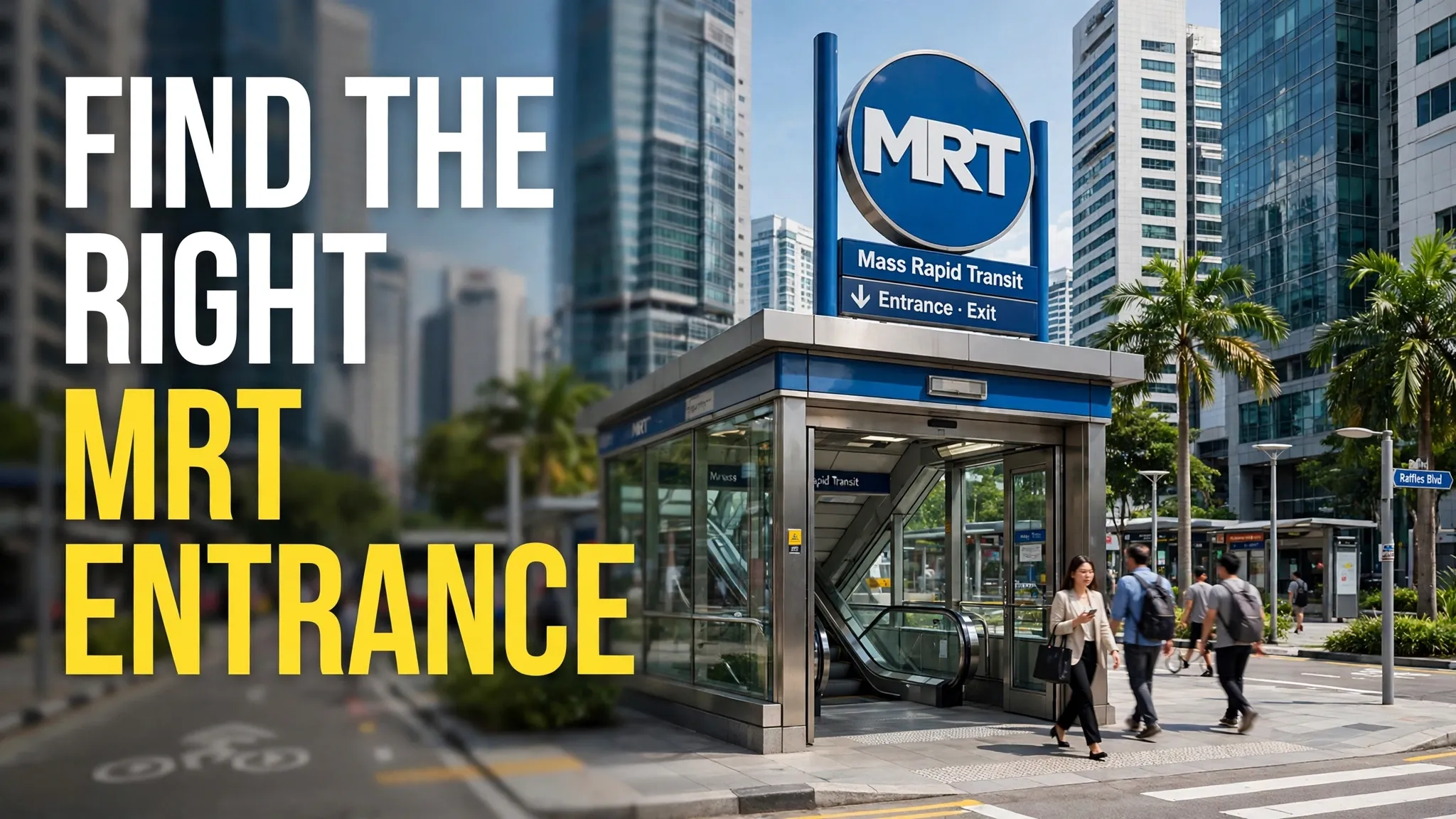
Finding the correct MRT station entrance in Singapore can save time, especially when you’re visiting an unfamiliar area or trying to reach a particular building. Singapore MRT entrances are marked with station names, public transport symbols and directional signs, while nearby landmarks can help you identify the most convenient access point. Stations such as Orchard, Bugis and Raffles Place have entrances around busy shopping and commercial areas, so choosing the right one matters. This MRT Entrance Guide explains how to find station entrances, read wayfinding signs, check accessibility facilities and reach the correct station access point.
TL;DR – MRT Entrance Guide at a Glance
Singapore MRT entrances provide access to station concourses, fare gates and train platforms. To find the correct entrance, check the station map, follow MRT signs and use nearby landmarks for direction. Some stations connect directly to shopping malls or underground walkways. Passenger lifts and barrier-free facilities are available at many stations, although facilities can vary by entrance.
| Quick information | Details |
|---|---|
| Entrance fee | No separate entrance charge |
| Station access | Marked MRT station entrances |
| Navigation | Station maps and directional signs |
| Train fare | Based on journey and passenger category |
| Accessibility | Lifts and barrier-free facilities |
| Official information | LTA and public transport operators |
What Is an MRT Entrance in Singapore?
An MRT entrance is a designated access point that allows passengers to enter a train station from a nearby street, building or connected pedestrian walkway. It leads towards the station concourse, where passengers can find fare gates, ticketing facilities and directions to the MRT platforms.
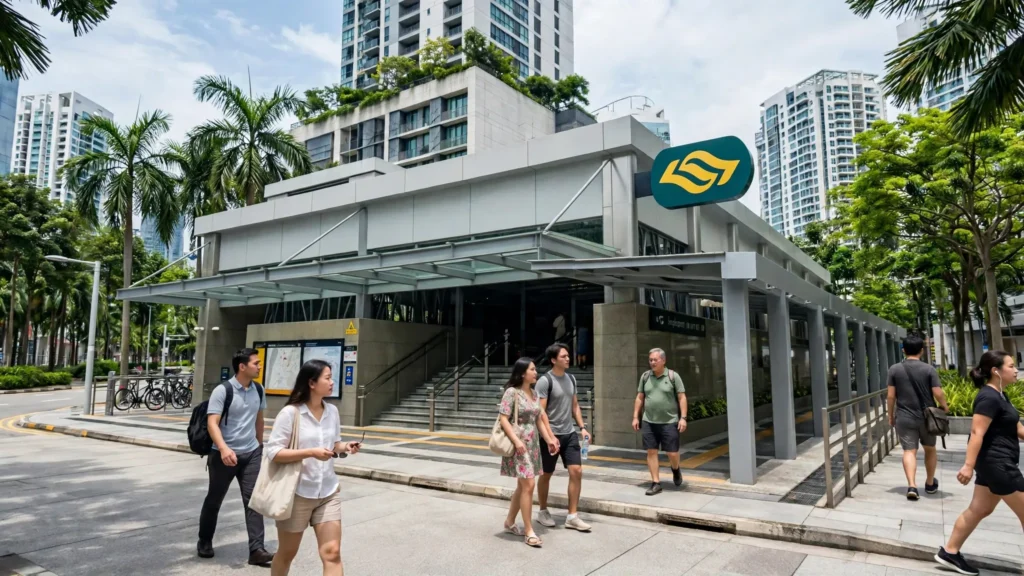
In Singapore, some entrances are at street level, while others are located inside shopping malls or underground pedestrian areas. You’ll usually find a public transport symbol and the station name near the entrance.
The entrance you choose can affect how much walking you need to do before reaching the fare gates. At larger stations, checking the entrance location first can make your journey easier.
How to Find MRT Entrances in Singapore
Finding an MRT entrance is easier when you check the station location before setting off. Don’t rely only on the station name — a large station may have several access points on different streets.
Follow these steps to find the nearest MRT entrance in Singapore:
- Search for your nearest MRT station: Identify the station closest to your current location or destination. Check its station name and line information.
- Check the entrance map: Look for a station map or entrance directory to see where the access points are located.
- Identify nearby landmarks: Buildings, shopping malls, road names and well-known attractions can help you work out which direction to walk.
- Follow MRT signage: Look for the public transport symbol and signs displaying the station name.
- Check directional signboards: Read the directions before entering, particularly around busy roads and large developments.
- Confirm the station entrance: Once you reach the correct access point, follow the signs towards the concourse and fare gates.
| Step | What to check | Why it matters |
|---|---|---|
| 1 | MRT station name | Identifies the correct station |
| 2 | Entrance map | Shows nearby access points |
| 3 | Nearby landmarks | Helps you choose a walking direction |
| 4 | MRT signage | Confirms the station entrance |
| 5 | Station directory | Provides directions inside the station |
For example, someone heading to Bugis Junction should check the Bugis MRT station map and nearby street signs rather than assuming every entrance leads to the same part of the shopping area.
MRT Entrance vs MRT Exit – What’s the Difference?
An MRT entrance is used to enter a station from outside, while an MRT exit helps passengers leave the station after arriving. Both are part of the station’s access system, but they serve different purposes.
Entrance information is useful before starting a journey. Exit directories are particularly helpful when you’re already at the station and need to reach a shopping mall, office, attraction or nearby street.
| Feature | MRT Entrance | MRT Exit |
|---|---|---|
| Purpose | Enter the station | Leave the station |
| Direction | Street to station | Station to street |
| Main signs | Station and entrance signage | Exit letters or numbers, where provided |
| Navigation stage | Before boarding | After arriving |
| Useful for | Finding station access | Reaching nearby destinations |
Don’t assume that the entrance closest to your starting point will also be the best exit for your destination. Check the station’s exit directory when planning the return journey.
How to Identify the Correct MRT Entrance
You can identify the correct MRT entrance by checking the station name, public transport symbol, directional signs and nearby building names. Entrance markers and locality maps can also show which access point is closest to your destination.
Pay attention to station codes as well. For example, Orchard MRT Station has the codes NS22 and TE14, reflecting its connections to two MRT lines. Station codes are useful when checking journey information, but they don’t replace entrance directions.
Look for these signs and details:
- Station name: Confirms that you’re approaching the correct MRT station.
- Public transport symbol: Helps identify the station access point.
- Directional signboards: Show the direction of the station and nearby facilities.
- Building names: Useful around shopping malls and commercial developments.
- Lift and escalator signs: Help you find a suitable route into the station.
- Locality maps: Show nearby roads, buildings and destinations.
At an unfamiliar interchange, take a moment to check the signs before walking further. It can save you from doubling back.
MRT Entrances at Major Singapore Stations
Singapore’s major MRT stations serve busy shopping districts, commercial areas and transport hubs. Their entrances may be spread across different streets or connected developments, so checking the surrounding area is useful.
Orchard MRT Station
Orchard MRT serves the Orchard Road shopping district. The station is connected to a busy area with shopping malls, retail buildings and underground pedestrian links. If you’re visiting a particular mall, check its location against the station’s entrance information before choosing where to enter.
Bugis MRT Station
Bugis MRT is useful for reaching Bugis Junction, Haji Lane, the National Library and nearby streets. The surrounding area has several popular destinations, so the closest entrance may depend on where you’re going.
Raffles Place MRT Station
Raffles Place MRT serves Singapore’s Central Business District. Its entrances provide access to nearby office buildings, commercial developments and surrounding streets. Office workers and visitors should check the nearest access point to their building.
Marina Bay MRT Station
Marina Bay MRT serves the Marina Bay area and nearby developments. Some destinations are reached through connected buildings or pedestrian routes, so allow time for walking between the station and your final stop.
Changi Airport MRT Station
Changi Airport MRT provides train access to the airport. Passengers can follow airport and MRT signs to reach the station from the terminal area. Check the signs at your terminal so you follow the correct route.
MRT Entrances Connected to Shopping Malls and Streets
Some Singapore MRT stations have direct connections to shopping malls, commercial buildings and underground pedestrian walkways. Orchard Road and Bugis are familiar examples, where station access is closely linked with surrounding retail areas.
But not every nearby building has a direct MRT entrance. In some cases, you’ll need to walk along a covered or underground pedestrian route before reaching the station.
Check the station map and building directions before leaving. If you’re meeting someone at a mall, agree on a specific entrance or landmark rather than simply saying you’ll meet at the MRT.
Wheelchair-Accessible MRT Entrances and Barrier-Free Access
Many Singapore MRT stations provide passenger lifts and barrier-free routes for wheelchair users, passengers with strollers and people who have difficulty using stairs. Tactile guiding systems and Priority Use signs also support passengers who need additional assistance.
However, facilities may differ between stations and individual access points. Don’t assume that every entrance has a lift or the same step-free route.
| Accessibility feature | Purpose |
|---|---|
| Passenger lifts | Provide step-free access between levels |
| Tactile paving | Helps passengers with visual impairments follow routes |
| Priority Use signs | Identify facilities intended for priority passengers |
| Barrier-free routes | Reduce the need to use stairs |
| Accessible fare gates | Provide suitable passage for passengers with mobility needs |
Before travelling, check the station’s facility information and identify an accessible entrance. If you’re unsure, ask staff at the Passenger Service Centre for directions.
Common MRT Entrance Mistakes to Avoid
A few simple mistakes can add unnecessary walking time to your journey. Watch out for these:
- Choosing an entrance far from your actual destination.
- Confusing station entrances with exit directions.
- Ignoring underground pedestrian connections.
- Missing signs for passenger lifts.
- Assuming every entrance has identical facilities.
- Walking towards a station without checking its map first.
At large interchange stations, don’t rush past directional signs. A quick check can save you from taking the wrong route.
Tips for Finding the Nearest MRT Entrance
Check MyTransport.SG or official station information before travelling. Search the MRT station name together with your nearby landmark, then compare the walking route with the entrance map. Follow directional signboards once you’re in the area.
If you need lift access, check the station facilities in advance. Allow extra walking time at large interchange stations, especially when you’re unfamiliar with the surrounding streets or shopping developments.

Frequently Asked Questions
1. How do I find the nearest MRT entrance in Singapore?
Search for the nearest MRT station, check its entrance map and use nearby landmarks to identify the correct access point. Follow the station signs when you arrive.
2. Do Singapore MRT entrances have an entry fee?
No. There is no separate charge for entering an MRT station. You pay the applicable train fare when travelling through the fare gates.
3. Are MRT entrances and exits the same?
No. Entrances provide access from outside the station, while exits take passengers from the station towards nearby streets and destinations.
4. Are Singapore MRT entrances wheelchair accessible?
Many stations have passenger lifts and barrier-free routes. Facilities vary, so check the specific station and entrance before travelling.
5. Can I enter an MRT station through a shopping mall?
Some MRT stations have direct connections to shopping malls and underground walkways. Access depends on the station, building connection and opening arrangements.
Conclusion
Finding the right MRT Entrance Guide in Singapore starts with checking station maps, signage and nearby landmarks. Pay attention to lift access if you need a barrier-free route, and check the station information before travelling. A little preparation can make reaching your MRT station much easier.
[…] MRT Entrance Guide Singapore: How to Find the Right Station Entrance (2026) MRT Barrier Free Access Singapore: Wheelchair Facilities, Lifts & Accessible Routes (2026) MRT Accessibility Guide Singapore: Wheelchair Access, Lifts and Facilities MRT Bicycle Parking in Singapore: Locations, Rules and Tips MRT Station Parking in Singapore: Locations, Rates & Tips MRT to Singapore Zoo: How to Get There MRT to VivoCity Singapore: Route, Exits & Fares MRT to Universal Studios Singapore: How to Get There MRT to Gardens by the Bay: Stations, Exits & Walking Routes MRT to Chinatown Singapore: Routes, Exits & Travel Time […]