

 By admin
Singapore’s rail network is one of the easiest ways to travel between residential neighbourhoods, shopping districts, business areas and popular attractions. This Singapore Rail Guide covers the MRT and LRT systems, train lines, maps, fare payment options and practical routes for everyday commuters and visitors. You’ll also find advice on travelling from Changi Airport, choosing a payment method and checking train timings before leaving home or your hotel. A little route planning can save time, especially when your journey involves a transfer or a station with several exits.
TL;DR: Singapore Rail Guide at a Glance
Singapore’s public rail network includes the Mass Rapid Transit (MRT) and Light Rail Transit (LRT) systems. Use the official LTA train map to check lines, station codes and interchanges. Eligible contactless bank cards, supported mobile wallets and transit cards can be used for fares. Changi Airport has an MRT station, but most city-bound journeys require a transfer. Check current fares, service notices and first or last train timings before travelling.
How Does Singapore’s Rail System Work?
Singapore’s train system has two main parts: MRT and LRT. The Mass Rapid Transit (MRT) network connects major town centres, residential districts, shopping areas and places of work. It is the main choice for longer journeys across the island. The Light Rail Transit (LRT) serves selected residential areas, with feeder connections to nearby MRT stations. You’ll find LRT networks in places such as Bukit Panjang, Sengkang and Punggol. For many journeys, the train gets you close to your destination, while a bus or a short walk completes the trip. You can plan routes using the LTA transport tools and check bus connections where needed. If you’re travelling during peak hours, allow extra time for crowded platforms and interchange walks.
Singapore MRT Lines and Their Main Connections
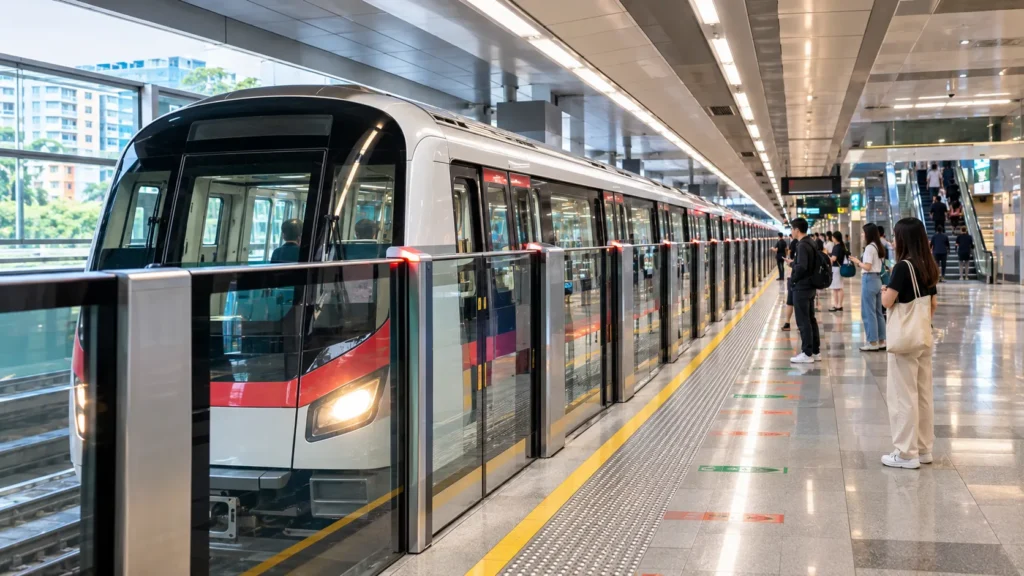
Singapore has six main MRT lines. Each uses a colour and a line abbreviation on the network map, making it easier to identify your route and transfer points. Check the official MRT/LRT map for current stations and service changes.
| MRT line | Map colour | Main role |
|---|---|---|
| North-South Line (NSL) | Red | Connects northern areas with central Singapore and the south |
| East-West Line (EWL) | Green | Runs across the island, including connections towards Changi Airport via a branch |
| North East Line (NEL) | Purple | Serves north-eastern neighbourhoods and central areas |
| Circle Line (CCL) | Orange | Links several central districts and connects with other MRT lines |
| Downtown Line (DTL) | Blue | Serves central-city areas and corridors towards the north-west and east |
| Thomson-East Coast Line (TEL) | Brown | Connects northern, central and eastern parts of Singapore |
How should you choose a line? Start with your nearest station and the station closest to your destination. Then check whether you can travel directly or need to change trains. An interchange may be convenient, but some stations involve a longer walk between platforms. If your journey crosses several lines, follow the station signs rather than relying on memory alone.
Singapore MRT Map: How to Read It
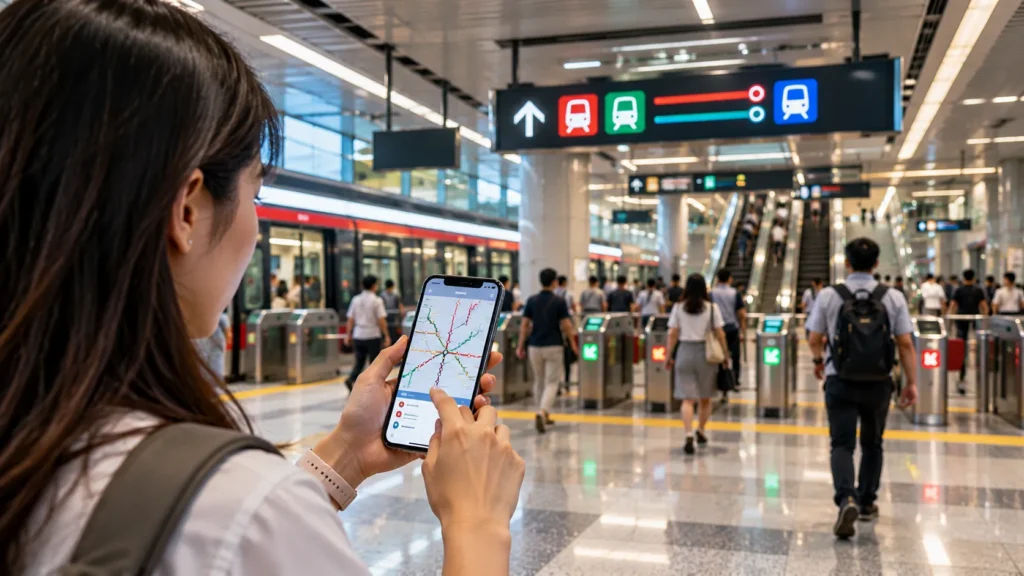
The official Singapore MRT map is available through the Land Transport Authority (LTA). Keep a digital copy on your phone, particularly if you’re visiting for the first time. Each line has a colour and abbreviation, while station codes help you identify individual stops. For example, EW refers to the East-West Line, while DT identifies the Downtown Line. A station served by more than one line is an interchange, where you can transfer to another route. Before setting off, check the destination station, transfer points and station exits. The nearest station isn’t always right beside the attraction, and choosing a different exit can save a fair amount of walking. For live service notices, use official transport updates instead of relying only on an old map screenshot.
Singapore MRT Fares and Payment Methods
Singapore MRT fares depend on the journey distance, applicable fare rules and payment method. Before travelling, check the latest fare information using the Public Transport Council fare resources or SimplyGo.
| Payment method | What to know |
|---|---|
| Contactless bank card | Supported contactless Visa, Mastercard and American Express cards may be accepted, subject to card eligibility |
| Mobile wallet | Works when the wallet and linked card are supported for transit payment |
| EZ-Link card | A stored-value option for public transport; check card cost, top-up requirements and applicable terms |
| Singapore Tourist Pass | Offers eligible visitors travel benefits for a specified validity period; compare the current pass terms with your planned trips |
| Single-journey ticket | Check current availability and purchase options before relying on this method |
For foreign-issued contactless Visa and Mastercard cards, SimplyGo states that a S$0.60 foreign bank card admin fee applies per day of use. Your bank may also charge its own foreign transaction or currency conversion fees.
A few practical points: use the same card or device when tapping in and out, and don’t assume two different cards linked to the same account will be treated as one journey. If you’re visiting for several days, compare expected fares with the current Singapore Tourist Pass terms. The cheapest option depends on how often you travel and which services you plan to use.
How to Get from Changi Airport to the City by Train
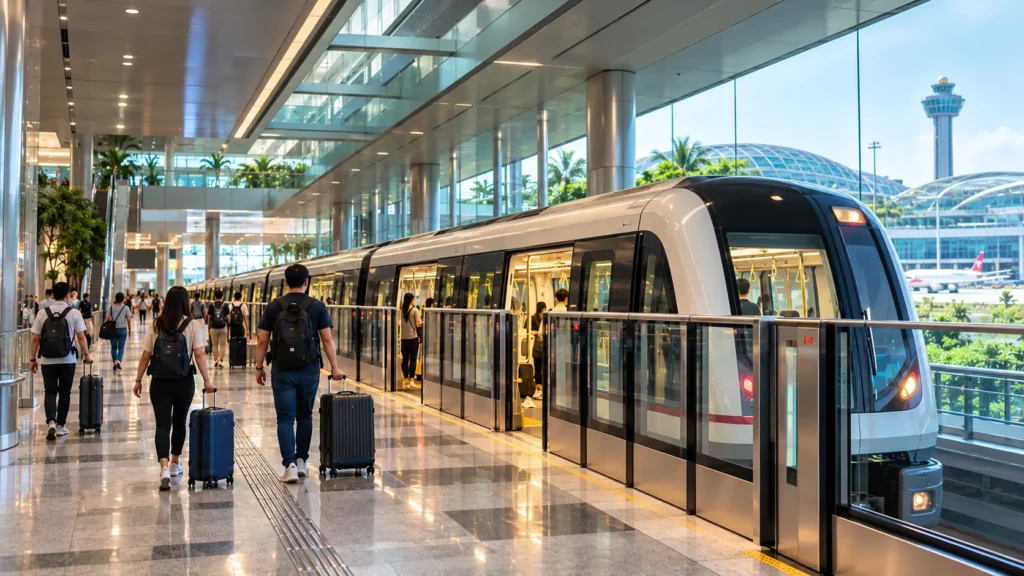
Changi Airport has an MRT station connected to Terminals 2 and 3. To reach the city, take the train from Changi Airport station and transfer at Tanah Merah for the East-West Line towards the city, or at Expo for the Downtown Line. The better option depends on your final destination.
Check the route before boarding, especially if you’re arriving late at night. Public train services do not run all night, so a late arrival may require another transport option. You can check station connections and current service details through the official LTA train map.
If you have large suitcases or are travelling with young children, allow extra time for transfers and lifts. The airport connection is straightforward once you know which line you need — but your final destination determines where you should change trains.
MRT Routes to Popular Singapore Attractions
These station suggestions are useful starting points. Check the current map and the attraction’s own directions before choosing your exit.
| Destination | MRT station to consider | Travel tip |
|---|---|---|
| Marina Bay | Marina Bay or Bayfront, depending on the destination | Check the exact attraction address before choosing a station |
| Orchard Road | Orchard or Somerset | Choose based on the shopping mall or stretch of road you plan to visit |
| Chinatown | Chinatown | The station connects with the North East and Downtown lines |
| Bugis | Bugis | Useful for the Bugis shopping area and nearby streets |
| Gardens by the Bay | Gardens by the Bay or Bayfront | Gardens by the Bay station is on the Thomson-East Coast Line; Bayfront connects with the Circle and Downtown lines |
For Gardens by the Bay, the official visitor information lists Gardens by the Bay MRT station (TE22), Exit 1, and Bayfront station (CE1/DT16), Exit B, as access options.
If you’re heading to Sentosa, plan for an onward connection after reaching the HarbourFront area. The best route can change depending on which part of the island you want to visit.
Singapore Train Operating Hours and Travel Tips
MRT operating hours vary by line, station and service conditions. First and last train times can also differ by direction, so check the relevant operator’s latest information rather than assuming every service starts or ends at the same time.
- Check timings: Confirm the first or last train if you have an early flight or late-night plans.
- Allow time for transfers: Some interchanges require a longer walk between platforms.
- Follow station signs: Line colours, station codes and destination boards help you board the correct train.
- Check disruptions: Review official service updates before leaving, particularly during planned maintenance.
- Check accessibility: Look up lift access and station facilities if you use a wheelchair or need step-free travel.
A saved map is handy, but current service information matters just as much.
Frequently Asked Questions
How does the Singapore rail system work?
Singapore’s rail network combines MRT lines for island-wide travel with LRT services that connect selected residential areas to nearby MRT stations.
How do tourists pay for Singapore MRT rides?
Visitors may use eligible contactless bank cards, supported mobile wallets, transit cards or a Singapore Tourist Pass. Check card eligibility and fees first.
Where can I find the Singapore MRT map?
Use the official LTA MRT/LRT map to check lines, station codes and interchanges.
How do I travel from Changi Airport to the city by train?
Take the MRT from Changi Airport and transfer at Tanah Merah to the East-West Line or at Expo to the Downtown Line, depending on your destination.
What time do Singapore MRT trains start and stop?
Timings vary by line and direction. Check the relevant operator’s latest first and last train information before travelling, especially at night.
Conclusion
The Singapore Rail Guide starts with three simple checks: choose your route, confirm the fare and check current train timings. The official rail map helps you identify lines and transfers, while service updates can save you a stressful last-minute change of plans. Check official information before each journey.
[…] Singapore Transit Guide is useful when you have a connecting flight at Changi Airport and need to work out what happens […]