

 By admin

Singapore’s train network makes it easy to travel between residential neighbourhoods, shopping districts and popular attractions without relying on taxis. This Singapore Train Guide covers the MRT and LRT systems, train map, fares, payment methods and routes from Changi Airport into the city. You’ll also find useful station suggestions for places such as Orchard Road, Chinatown and Marina Bay. Whether you live in Singapore or are visiting for a few days, checking your route and fare before leaving can save time — especially when your journey involves changing train lines.
TL;DR: Singapore Train Guide at a Glance
- MRT: Singapore’s main rail network; LRT: shorter rail services serving selected neighbourhoods.
- Payment: Eligible contactless bank cards, supported mobile wallets and transit cards can be used.
- Fares: Check the official fare information or SimplyGo fare page.
- Map and routes: Use the LTA MRT/LRT map.
- Airport: Check the LTA journey-planning tools before travelling from Changi Airport.
How Does Singapore’s Train System Work?
Singapore’s rail network links the city centre with housing estates, business areas, shopping streets and transport hubs. The Mass Rapid Transit (MRT) is the main train system, with routes that cross the island and connect at interchange stations. The Light Rail Transit (LRT) serves selected residential areas, linking neighbourhoods with nearby MRT stations.
MRT vs LRT in Singapore
MRT trains are useful for longer journeys across Singapore, while LRT services generally cover shorter local trips. Both use station gates and designated platforms, and both appear on the official rail map. Check the LTA MRT/LRT map to see which line serves your starting point and destination.
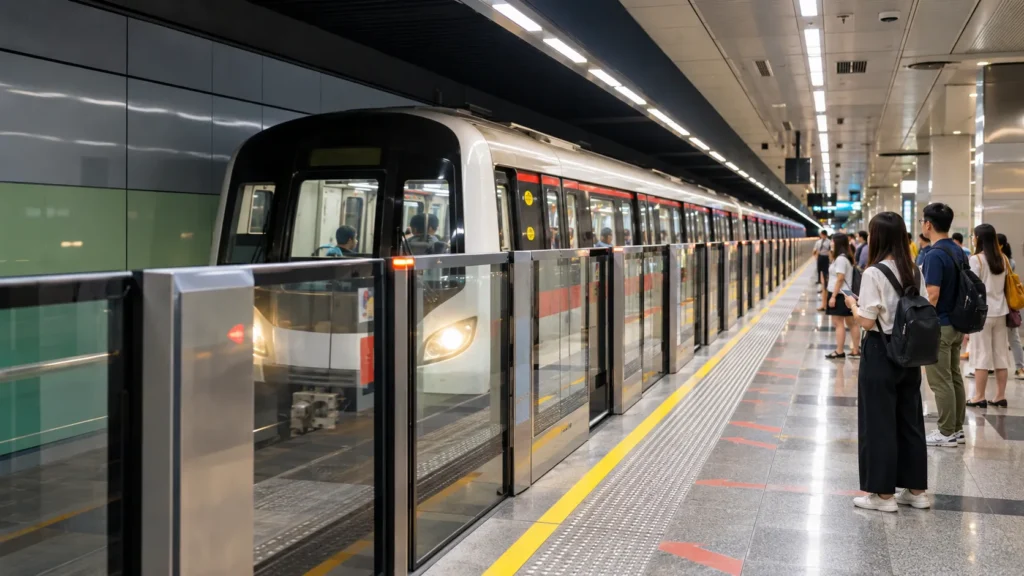
Singapore MRT Lines and Train Map
Singapore has several MRT lines, each shown in a different colour on the rail map. The colour and station code make it easier to identify the correct platform and direction.
Main MRT Lines and Their Colours
| MRT line | Map colour | General route coverage |
|---|---|---|
| North-South Line (NSL) | Red | North and central Singapore, including Orchard and Marina Bay connections |
| East-West Line (EWL) | Green | East to west, including Changi Airport connections via Tanah Merah |
| North-East Line (NEL) | Purple | North-eastern areas and HarbourFront |
| Circle Line (CCL) | Orange | A loop linking several central and city-fringe stations |
| Downtown Line (DTL) | Blue | Central areas and neighbourhoods to the north-west and east |
| Thomson-East Coast Line (TEL) | Brown | Northern and eastern areas, with connections through central Singapore |
How to Read the Singapore MRT Map
Look for the station code beside each station name. The letters identify the line, while the number identifies the station along that line. Interchange stations are marked where passengers can change trains. Before boarding, check the train’s direction and final station name — two trains on the same line may travel in opposite directions. For live route planning, use the official LTA map rather than relying on an old screenshot.
Singapore Train Guide: Singapore MRT Fares and Payment Options
How Much Does the MRT Cost in Singapore?
Singapore MRT fares are distance-based, so the amount depends on how far you travel and the fare category that applies. Under the fare structure listed by the Public Transport Council, adult card fares for basic train and bus services start at S$1.28 for journeys up to 3.2 km; longer trips cost more. Fare changes are scheduled to take effect on 26 December 2026, so check the current rate before travelling.
Use the Public Transport Council fare table or SimplyGo fare information to check fares. Foreign-issued Visa and Mastercard contactless cards incur an additional S$0.60 administration fee per day of use. Your bank may also charge its own fees.
Which Payment Option Should You Choose?
| Payment method | How it works | Best for | Important consideration |
|---|---|---|---|
| Contactless bank card | Tap the eligible card at entry and exit | Residents and visitors who prefer not to top up a travel card | Foreign-issued Visa and Mastercard cards have a daily admin fee |
| Mobile wallet | Tap a supported card in a compatible phone or watch wallet | Travellers who pay by phone or watch | Use the same device for entry and exit |
| EZ-Link / SimplyGo EZ-Link card | Use a stored-value travel card | Frequent trips and people who prefer a separate transit card | Check the card balance and top-up options |
| Singapore Tourist Pass | Offers unlimited rides on eligible basic public bus and train services during its validity | Visitors making several trips over consecutive days | Some premium services, including the Sentosa Express, are excluded |
The Singapore Tourist Pass currently lists S$17 for one day, S$24 for two days and S$29 for three days, with four- and five-day options also available. It may suit visitors planning lots of train and bus journeys, but paying per ride can cost less if you only make a few trips. Check the official Tourist Pass website for validity rules and current details.
How to Use the MRT in Singapore
Step-by-Step Train Travel
- Search your destination. Use the official rail map or a journey planner to see the route and estimated fare.
- Find the correct station and line. Check the station name, line colour and train direction.
- Tap in at the fare gantry. Use an accepted contactless card, mobile wallet or transit card.
- Follow the platform signs. If you need to change trains, follow the signs for the connecting line at the interchange station.
- Tap out at your destination. Use the same physical card or device you tapped in with, so the trip can be recorded correctly.
Allow extra time if you’re unfamiliar with a large interchange. Some stations have long corridors between lines, and the exit closest to your destination may not be the one you expect. Check the station signs before leaving the paid area.
How to Travel from Changi Airport to the City by Train
Planning Your Airport MRT Journey
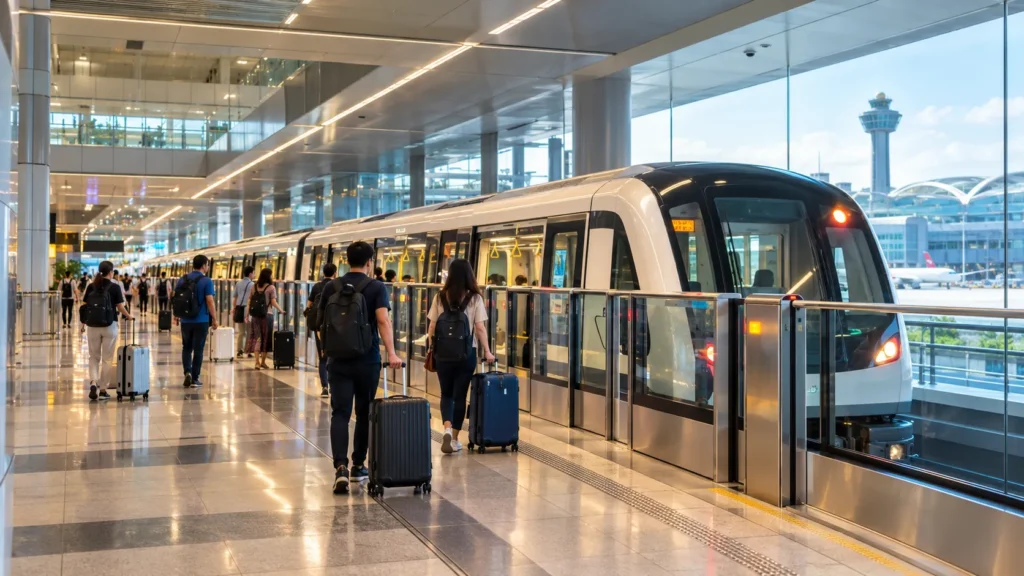
Changi Airport has an MRT station connected to the rail network. A common route into the city involves travelling to Tanah Merah and changing to a westbound East-West Line train. Depending on where you’re staying, another connection may suit you better, so enter your hotel or destination into the LTA journey-planning tools before boarding.
With luggage, allow time to find lifts, follow station signs and move between platforms. If you arrive late at night, check the last train for your route first; airport arrival time and train departure time are not the same thing.
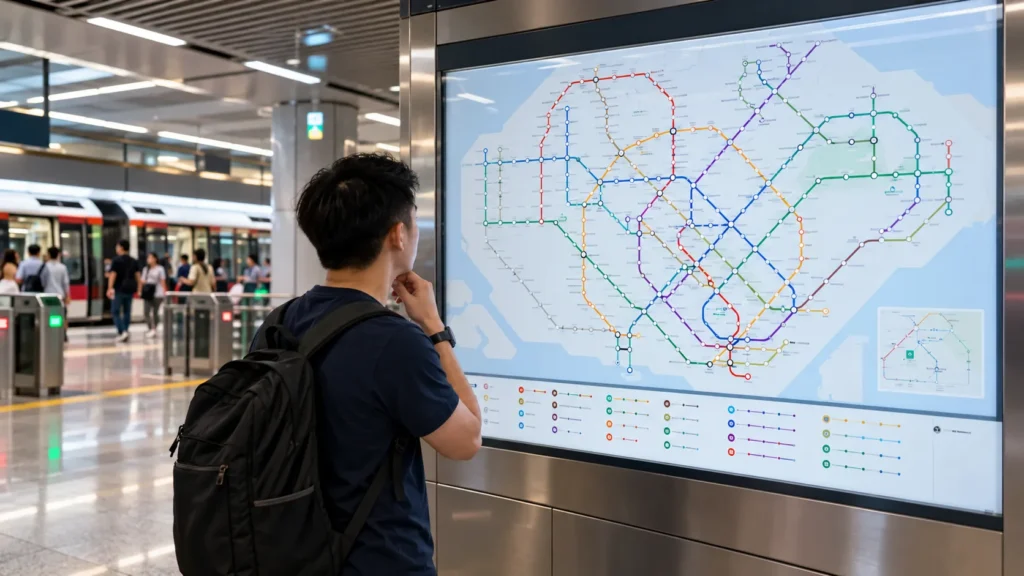
MRT Stations for Popular Singapore Attractions
Singapore sightseeing by MRT is straightforward, but some attractions are a short walk from the station and others need a bus connection or another train. Check the route and station exit before setting off.
| Attraction | Convenient station or rail connection | Route-planning tip |
|---|---|---|
| Marina Bay | Marina Bay, Bayfront or Downtown, depending on your destination | Check which part of the waterfront you want to visit |
| Orchard Road | Orchard or Orchard Boulevard | Look at the nearest mall or address to choose the best exit |
| Chinatown | Chinatown | The station connects with the North-East and Downtown lines |
| Gardens by the Bay | Gardens by the Bay on the TEL, or Bayfront for access to the main gardens area | Check walking directions for your chosen entrance |
| HarbourFront and Sentosa | HarbourFront | Follow signs to VivoCity and the Sentosa access points |
Use the LTA rail map to confirm connections. Station choice matters: the closest rail stop can differ depending on the entrance, building or attraction area you’re visiting.
Singapore Train Guide: Timings and Travel Tips
First and Last Train Timings
Many services begin at around 5.30 am and run until around midnight, but there is no single timing for every station and direction. First and last train times can vary by line, day and destination.
| What to check | Why it matters | Where to check |
|---|---|---|
| First and last train | Avoid arriving after the final service | SMRT station timetables |
| Service disruptions | Planned work or delays can affect your route | LTA and train operator updates |
| Peak-hour crowds | Trains and platforms can be busy on weekday mornings and evenings | Plan extra travel time |
| Accessibility | Lifts and step-free routes can affect your station choice | Check station information and signs |
If you’re travelling with a pram, wheelchair or heavy luggage, look for lift symbols on the station map. And before a late-night journey, check the timetable for the exact station and direction — don’t rely on a general closing time.
Frequently Asked Questions
How much does the MRT cost in Singapore?
Adult card fares currently start at S$1.28 for a basic journey of up to 3.2 km, with higher fares for longer distances. Check the official fare table for current rates, as changes are scheduled from 26 December 2026.
Can tourists use contactless credit cards on the MRT?
Yes. Eligible contactless American Express, Mastercard and Visa cards can be used, along with supported mobile wallets. A S$0.60 daily administration fee applies to foreign-issued Visa and Mastercard cards. Check card eligibility and overseas-use settings before travelling.
What time do Singapore trains start and stop?
Many services run from around 5.30 am until around midnight, but timings vary by station, line, direction and day. Check the operator’s station-specific timetable before an early start or late return.
How do I get from Changi Airport to the city by train?
Take the MRT from Changi Airport and check whether changing at Tanah Merah or another connection suits your destination. Use the LTA journey-planning tools to confirm the route before travelling.
Is the Singapore Tourist Pass worth buying?
It can be useful if you plan to make many eligible bus and train journeys over consecutive days. If you’ll only take a few rides, paying individual fares may be cheaper. Compare your likely trips with the official pass prices and conditions.
Conclusion: Plan Your Singapore Train Journey
Singapore’s MRT and LRT network connects many residential areas, transport hubs and visitor attractions. Before leaving, check your route, fare and train timing using official sources. A quick look at the Singapore Train Guide and current service information can make the trip easier to plan.
[…] Singapore Train Guide for First-Time Visitors Singapore Public Transport: How to Travel, Pay and Plan Your Journey Singapore MRT Fare Guide: Fares, Payment Methods & Travel Tips Singapore MRT Card Guide: Prices, Best Options & How to Use Them Yio Chu Kang MRT Guide 2026: Exits, Routes & Nearby Places Jurong East MRT Guide: Lines, Exits & Nearby Places Woodlands MRT Guide: Routes, Exits and Nearby Places Yishun MRT Guide: Exits, Bus Interchange & Nearby Places Khatib MRT Guide: Train Timings, Exits & Nearby Places Bishan MRT Guide 2026: Exits, Timings, Lines & Nearby Places […]