

 By admin
The O-Level periodic table is a reference chart that organises chemical elements by atomic number and repeating chemical properties. For Singapore-Cambridge O-Level Chemistry, the 2026 syllabus states that a copy of the Periodic Table of Elements is printed as part of the paper. That means students should learn how to read and apply the chart, rather than spend time memorising every element’s atomic mass.
The table helps you identify an element’s symbol, proton number, relative atomic mass and position in a group or period. Those details support questions about electronic structure, ions, bonding, reactivity and the properties of metals and non-metals. Knowing where information appears is useful, but exam marks come from explaining what it means.
What is the O-Level periodic table?
The periodic table is a structured arrangement of chemical elements. Each element occupies a position based on its atomic number, which is the number of protons in its nucleus. Elements with similar outer-electron arrangements are placed in the same vertical group, so they often show related chemical behaviour.
In Singapore, “O-Level periodic table” usually refers to the table used in the Chemistry examination or in school revision. The exact presentation may vary slightly across textbooks, practice papers and examination resources, so use the table supplied for your syllabus and year as your main reference.
The SEAB 2026 Chemistry syllabus says that a copy of the Periodic Table of Elements will be printed as part of the paper. Check the current official syllabus for your own examination year because subject codes and assessment details can change.
How to read an element box
An element square normally shows its chemical symbol, element name, proton number and relative atomic mass. The exact layout depends on the table, so identify the labels or learn the common arrangement before an examination. Do not assume a number’s meaning from its position alone when the table includes headings.
| Information | What it tells you | How students use it |
|---|---|---|
| Element symbol | Short chemical abbreviation, usually one or two letters | Write formulas and identify elements in equations |
| Proton number (atomic number) | Number of protons in the nucleus | Identify the element and, for a neutral atom, the number of electrons |
| Relative atomic mass | Weighted average mass of the element’s atoms relative to a standard | Use in formula mass and mole calculations when required |
| Group | Vertical column in the table | Relate main-group position to outer electrons and chemical behaviour |
| Period | Horizontal row in the table | Relate position to the number of occupied electron shells in simple models |
The chart may also show state, colour or other facts, depending on the source. At O-Level, focus on information required by your syllabus and the question. If a question supplies an unfamiliar element or data, read the labels and use the information provided instead of relying on memory.
Atomic number, protons and electrons
The proton number defines the element. Every atom of carbon has six protons, and every atom of sodium has eleven. Changing the number of protons changes the identity of the atom, which is why proton number is more fundamental than the atom’s mass.
For a neutral atom, the number of electrons equals the number of protons. An atom becomes an ion when it gains or loses electrons, but its proton number stays the same. For example, a sodium ion still has the proton number of sodium even after it loses an electron.
When a question asks for the number of electrons in an ion, combine the proton number with the ionic charge. A positive charge means electrons have been lost; a negative charge means electrons have been gained. Write the reasoning clearly so you do not confuse electron number with proton number.
Relative atomic mass and mass number
Relative atomic mass on a periodic table is generally a weighted average that reflects the naturally occurring isotopes of an element. It is not necessarily a whole number. Mass number, by contrast, refers to the total number of protons and neutrons in one particular atom or isotope.
These terms are related but not interchangeable. If a question asks about one isotope, use its mass number and proton number to work out the neutrons. If it asks for a relative formula mass or a mole calculation, use the relative atomic masses supplied in the table or question.
At school level, an exam question will often give enough information to perform a calculation. Check whether the question expects a rounded value and carry units where appropriate. Avoid replacing a supplied data value with a memorised approximation when the question has provided a specific one.
Groups and periods
Groups are the vertical columns of the periodic table, and periods are the horizontal rows. Students use these positions to identify patterns in outer electrons, physical properties and chemical reactions. The table is not simply a list arranged for convenience; its structure reflects repeating patterns.
For the main-group elements studied at O-Level, the group number can help you work out the number of outer-shell electrons using the convention taught in your syllabus. Transition elements do not follow the same simple relationship, and exact treatment depends on the course content. Learn the rule that applies to the elements in your syllabus rather than forcing it onto every column.
The period number can indicate the number of occupied electron shells in a simple shell model. This helps connect the table to electronic configuration. Again, use the model required by the examination; more advanced orbital theory is not usually needed for basic O-Level questions.
Why elements in a group have similar properties
Main-group elements in the same group have the same number of outer-shell electrons in the simple model used at this level. Outer electrons take part in chemical reactions, so elements with the same outer-electron count often form ions with similar charges and show similar reaction patterns.
Similarity does not mean every element behaves identically. Physical properties, reaction rates and the strength of observed effects can vary down a group. Questions often ask for both the trend and an explanation, so name the change in property and connect it to a relevant structural idea.
For example, Group 1 metals form positive ions by losing one outer electron. Group 17 non-metals form negative ions by gaining one electron in a simple ionic model. Group 18 elements have full outer shells and are generally unreactive compared with many other groups.
Important groups for O-Level Chemistry
Group 1: alkali metals
Group 1 elements are metals with one outer electron in the school-level model. They form ions with a single positive charge when they lose that electron. Their reactions with water become more vigorous down the group, a trend commonly used to test the relationship between position and reactivity.
When explaining this trend, refer to the increasing distance of the outer electron from the nucleus and the greater shielding by inner electron shells, as appropriate to the syllabus. These factors make the outer electron easier to remove down the group. State the direction of the trend and connect it to the structural reason.
Group 17: halogens
Group 17 elements are non-metals with seven outer electrons in the simple model. They tend to gain one electron to form ions with a single negative charge. Their reactivity generally decreases down the group, which contrasts with the Group 1 trend.
In displacement reactions, a more reactive halogen can displace a less reactive halide from solution. Use the reactivity order specified in your course and show which species is oxidised or reduced if the question asks for redox reasoning. Do not infer a reaction solely from the colour of a solution.
Group 18: noble gases
Group 18 elements have full outer shells in the basic model and are relatively unreactive. They exist as single atoms under ordinary conditions, unlike many common gases that form molecules. Their lack of a strong tendency to gain, lose or share electrons explains their low reactivity at this level.

Transition elements
Transition elements occupy the central block of the periodic table. They are generally metals and have properties that differ from the simple trends of the main groups. Depending on the syllabus, students may learn about coloured compounds, variable oxidation states or catalytic behaviour.
Use the exact scope of your course. If a question tests a property that has not been taught, it may provide data or context. The SEAB syllabus page links to the official subject documents for the relevant examination year.
Metals, non-metals and the periodic pattern
Metals are mostly found on the left and in the centre of the periodic table, while non-metals are mainly on the right. A zigzag boundary is often used to separate the broad regions, with metalloids near the dividing line in many classroom diagrams. The supplied examination table may not draw this boundary, so use element properties and position carefully.
Across a period, metallic character generally decreases as elements change from metals to non-metals. This connects to changes in how atoms tend to form ions or bonds. Down a group, the pattern depends on the group and property being discussed, so avoid writing “everything increases” or “everything decreases.”
Always identify the property named in the question. Atomic size, reactivity, metallic character and melting point do not necessarily follow one identical trend across every region. A precise response is better than a broad statement about the whole table.
Using the table to predict ions
For simple main-group elements, group position can help predict common ion charges. Metals on the left tend to lose electrons and form positive ions; non-metals on the right can gain electrons and form negative ions. The resulting charge reflects the number of electrons transferred in the model.
| Element type | Simple electron change | Typical ion charge in basic examples |
|---|---|---|
| Group 1 metal | Loses one electron | +1 |
| Group 2 metal | Loses two electrons | +2 |
| Group 17 non-metal | Gains one electron | −1 |
| Group 16 non-metal | Gains two electrons in common ionic examples | −2 |
| Group 18 element | Usually does not gain or lose electrons in simple compounds | Generally no common simple ion |
This is a useful starting pattern, not a universal rule for every element or compound. Transition metals can form ions with different charges, and polyatomic ions contain multiple atoms. Read the formula, context and syllabus instructions before predicting an ion.
Connecting the periodic table to electronic structure
The periodic table and electron arrangement explain each other. Proton number identifies how many electrons a neutral atom has, while the period and group help organise those electrons into shells and outer-electron patterns. This connection lets students move from an element’s position to a simple electron configuration.
For example, a neutral atom with proton number 11 has 11 electrons. In the shell model typically used at this level, these are arranged as 2,8,1. That arrangement places sodium in the third period and first group, matching its tendency to lose one outer electron.
When writing an electronic arrangement, count the electrons carefully and use the shell capacities taught in your syllabus. For ions, adjust the electron total for the charge before arranging them. A common error is to write the neutral atom’s arrangement for an ion without adding or removing electrons.
Connecting table position to bonding
The periodic table helps predict whether atoms may form ionic or covalent bonds in straightforward cases. Metals tend to lose electrons, and non-metals tend to gain or share them. A metal and a non-metal may form an ionic compound through electron transfer, while non-metals commonly share electrons in covalent molecules.

Do not use “left side equals ionic, right side equals covalent” as a replacement for understanding the substances in a question. The bond depends on the elements and the chemical context. Explain electron transfer or sharing and connect the explanation to the ions or molecule formed.
Use the table to identify symbols and relative atomic masses when writing formulas or calculating formula mass. Check the charge balance in ionic compounds: the total positive and negative charge must cancel in a neutral formula unit.
What the exam provides and what you should memorise
For Singapore-Cambridge O-Level Chemistry 6092 in 2026, the syllabus says a copy of the Periodic Table of Elements will be printed as part of the paper. That means candidates should not assume they must reproduce the entire chart from memory. The chart does not replace the need to understand how to interpret it.
Memorise the relationships and methods your course expects: how proton number identifies an element, how to determine electrons in a neutral atom or ion, how group position relates to outer electrons for relevant elements, and how to explain periodic trends. You should also know common element symbols and formulas required by your syllabus.
Exam arrangements can differ by subject code, paper and year. Check the current SEAB syllabus and exam instructions rather than relying on an old revision guide. For the 2026 syllabus, see the official Chemistry 6092 document; private candidates should confirm their own applicable syllabus listing.
How to use the table during a question
- Identify the element symbol in the question.
- Locate its element box and read the column labels before using any number.
- Record the proton number and relative atomic mass if needed.
- Use the group and period to infer only the patterns covered in your syllabus.
- For an ion, adjust the electron count according to its charge.
- Write the answer in the form requested, including units or explanation where needed.
- Check that the result is chemically sensible and matches the question’s wording.
This sequence reduces careless mistakes. A student may know the chemistry but lose marks by reading a relative atomic mass as the proton number or by overlooking that an ion has a different number of electrons from the neutral atom.
Common periodic-table exam mistakes
- Confusing proton number and mass number: Proton number counts protons; mass number counts protons plus neutrons in an isotope.
- Using a neutral atom’s electrons for an ion: Add electrons for a negative charge and remove them for a positive charge.
- Applying the group rule to every column: The simple outer-electron shortcut is for relevant main-group elements.
- Giving a trend without a reason: Explain the change using structure or electron attraction when required.
- Mixing up groups and periods: Groups are vertical; periods are horizontal.
- Assuming every number is an atomic mass: Read the table’s labels and layout.
- Ignoring the question’s data: Use supplied values rather than a rounded value from memory.
- Overexplaining beyond the syllabus: Answer with the relevant chemistry at the level requested.
Effective revision with the O-Level periodic table
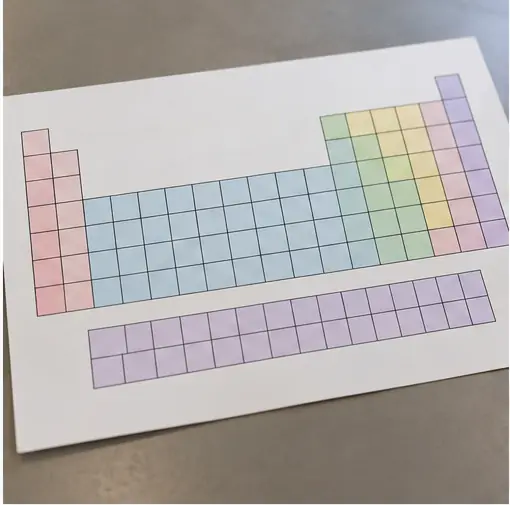
Use a blank copy for practice even if the exam supplies a table. Cover the labels and quiz yourself on groups, periods, element symbols and trends. This helps you locate information quickly under timed conditions without spending revision time memorising every atomic mass.
Practise with questions that require more than naming an element. Work through ion formation, electron arrangements, displacement reactions, formula writing and calculations. After answering, use the periodic table to check your reasoning and identify which part of the structure supports the conclusion.
Build a concise trend sheet from your syllabus. For each trend, record the direction, the group or period it applies to, and the explanation required. Keep exceptions separate so they do not blur the main pattern. If you are unsure whether a detail is examinable, compare it with the official syllabus or ask your teacher.
Choosing a reliable periodic table
For general chemistry reference, IUPAC maintains an up-to-date periodic table and educational resources. Its table can help with element names, symbols and standard reference information. However, school assessments may use a simplified layout, so students should practise with the actual examination-style table where available.
Use the IUPAC periodic table page for international reference and the SEAB syllabus for Singapore examination requirements. A poster found online may include orbital blocks, oxidation states or extra information that is beyond what your course needs.
When a table gives values with different precision, follow the values supplied in the paper. Do not assume that a more detailed table will improve an answer if the question expects a simple O-Level explanation.
Frequently asked questions
Will the O-Level Chemistry exam provide a periodic table?
The Singapore-Cambridge 6092 Chemistry syllabus for 2026 states that a copy of the Periodic Table of Elements is printed as part of the paper. Check the syllabus for your own examination year.
Do I need to memorise the whole periodic table?
You generally need to learn how to interpret it and know the symbols and patterns required by your syllabus. The official 2026 Chemistry syllabus says the table is provided in the paper.
What is the difference between a group and a period?
A group is a vertical column, while a period is a horizontal row. Their positions help you interpret patterns in electron arrangement and chemical properties.
What does proton number mean?
Proton number is the number of protons in an atom’s nucleus. It identifies the element and equals the electron number in a neutral atom.
Is relative atomic mass the same as mass number?
No. Relative atomic mass is a weighted average for an element’s atoms, while mass number counts protons and neutrons in a particular isotope.
How can I find the number of electrons in an ion?
Start with the proton number. Subtract electrons for a positive charge and add electrons for a negative charge.
What does the group number tell me?
For relevant main-group elements in the school-level model, the group helps identify the number of outer-shell electrons. Follow the convention taught in your syllabus.
Which periodic table should I use for revision?
Use the table supplied by your school or examination resources alongside the current SEAB syllabus. IUPAC is useful for general reference, but the exam’s own layout is best for practice.
Are all periodic table trends the same across every group?
No. Trends depend on the property and the part of the table being discussed. State the group or period and explain the specific trend named in the question.
Use the table as a chemistry tool
The O-Level periodic table is most useful when you can connect an element’s position to its structure and behaviour. Learn how to read the element box, distinguish proton number from relative atomic mass, and apply group and period patterns to the chemistry in your syllabus.
For Singapore candidates, check the current SEAB syllabus to confirm examination details for your year. Then practise using the periodic table as a tool for reasoning, not just a chart to look at during revision. For more local study resources, explore the Lion City Herald Education category.
Sources
- SEAB: 2026 O-Level Chemistry syllabus (6092)
- SEAB: 2026 O-Level syllabuses
- SEAB: O-Level school candidates
- Royal Society of Chemistry: Interactive periodic table
- IUPAC: Periodic table of elements