

 By admin
An A-Math formula sheet for Singapore students should do more than collect equations on one page: it should show which facts the examination supplies, which techniques you must practise, and how to choose the right method. For the 2026 Singapore-Cambridge O-Level Additional Mathematics paper, syllabus 4049 explicitly says relevant mathematical formulae will be provided. The official syllabus then lists formulae such as the quadratic formula, binomial expansion, trigonometric identities, sine and cosine rules, and the area formula for a triangle. This guide turns those references into a practical revision map without suggesting that every method can be replaced by memorisation.
The syllabus covers algebra, geometry and trigonometry, and calculus. A formula can help you start a question, but marks also depend on choosing the right model, showing essential working, interpreting answers and using appropriate accuracy. The 2026 assessment comprises two papers, each worth 50%, and the syllabus warns that omission of essential working can cost marks. Use the official 4049 document linked at the end as the authority for your examination year; check your teacher’s instructions if your school is preparing you for a later syllabus.
What Singapore students mean by an A-Math formula sheet
Students often use “formula sheet” to mean either a personal revision summary or the official mathematical formulae printed or made available for an examination. These are not the same thing. Your own sheet is a study aid you create to organise concepts. The examination’s supplied formulae are governed by the syllabus and paper instructions. Do not assume that a school-made sheet can be brought into the examination room, or that the official list contains every relationship you need to apply.
For the 2026 O-Level Additional Mathematics syllabus, SEAB states that relevant mathematical formulae will be provided to candidates. Its mathematical formulae section names selected results. That makes the official document more useful than a random internet “complete formula sheet”: it tells you the scope and labels the formulas the exam board identifies. It still does not tell you which result applies to every unfamiliar problem. Recognition, algebra, reasoning and accurate substitution remain your responsibility.
There is also a difference between memorising a formula and understanding its conditions. The quadratic formula solves an equation written in standard form. A trigonometric identity can simplify an expression only when the angle and function relationships are handled correctly. A differentiation rule applies to a function that fits the rule’s conditions. If you do not know what each symbol represents, copying a formula may produce a confident-looking but invalid step.
What the 2026 O-Level A-Math paper says
The 2026 syllabus is Additional Mathematics 4049. Paper 1 and Paper 2 are each 2 hours 15 minutes and carry 90 marks, or 50% of the subject weighting. Candidates answer all questions. The paper notes say that omission of essential working can result in loss of marks, that relevant mathematical formulae will be provided, and that non-exact numerical answers should normally be given to three significant figures or angles in degrees to one decimal place unless a question specifies another accuracy.
An approved calculator may be used in both papers, according to the syllabus. A calculator helps with numerical evaluation; it does not choose the correct method, prove an identity, explain a model or replace working. Practise using your calculator as a checking tool while writing the mathematical steps that communicate how you reached the answer.
The syllabus assumes knowledge from O-Level Mathematics, which may be needed indirectly even if not tested directly as a standalone topic. Keep core algebra, coordinate geometry, fractions, indices and ordinary trigonometry fluent. A-Math questions often combine assumed knowledge with a newer technique, so a revision plan that studies only the latest chapter can leave gaps.
Formulae listed in the official 4049 syllabus
| Area | Formula or relationship | How to use it |
|---|---|---|
| Quadratic equations | x = (−b ± √(b² − 4ac)) / 2a for ax² + bx + c = 0 | Substitute coefficients after arranging the equation in standard form. |
| Binomial expansion | (a + b)ⁿ = Σ ⁿCᵣ aⁿ⁻ʳbʳ for positive integer n | Use the general term to find a particular power or coefficient. |
| Trigonometric identities | sin²A + cos²A = 1; sec²A = 1 + tan²A; cosec²A = 1 + cot²A | Rewrite functions in a form that matches the expression you need. |
| Angle addition | sin(A ± B), cos(A ± B), tan(A ± B) expansions | Expand or combine angle expressions, keeping the plus/minus signs in order. |
| Double angles | sin 2A, cos 2A and tan 2A relationships | Choose the version that best fits the terms already in the question. |
| Triangle trigonometry | Sine rule, cosine rule, Δ = ½bc sin A | Match a known side-angle pair or included angle before selecting a rule. |
The table is a student-friendly summary, not a replacement for the official notation or full syllabus. Some formula symbols may display differently across devices. In the official PDF, check the printed expressions, diagrams and conditions before using a formula in a solution. You should also know what the coefficients in the binomial general term mean and how the sine and cosine rules connect sides with opposite angles.
Quadratics: formula, discriminant and completing the square
For ax² + bx + c = 0, identify a, b and c only after moving every term to one side and writing the equation in descending powers. If the equation is 2x² + 3 = 5x, rewrite it as 2x² − 5x + 3 = 0 before substitution. This simple rearrangement prevents sign errors, which are among the most common reasons a correct method produces the wrong roots.
The expression b² − 4ac is the discriminant. It helps classify the roots of a quadratic: positive means two distinct real roots, zero means equal real roots, and negative means no real roots. In A-Math, the discriminant can also appear in questions about the relationship between a line and a curve. Substitute the line into the curve to obtain a quadratic, then use the discriminant to decide whether there are two intersections, a tangent, or no real intersection.
The quadratic formula is supplied, but completing the square remains a syllabus technique and is useful for finding the maximum or minimum of a quadratic. Rewriting ax² + bx + c in the form a(x − h)² + k shows the vertex directly. If a is positive the graph opens upward and k is the minimum; if a is negative it opens downward and k is the maximum. Check the domain if the question restricts x, because the vertex may not lie in the allowed interval.
Quadratic inequalities need more than a root calculation. Find the critical values, determine the sign of the quadratic in each interval, and express the solution set clearly on a number line or with inequality notation. Test one value in each interval if you are unsure about the sign pattern. Include or exclude endpoints according to the inequality symbol and whether the expression is defined there.
Binomial expansion and coefficient questions
The binomial theorem applies to (a + b)ⁿ when n is a positive integer. The general term is ⁿCᵣ aⁿ⁻ʳbʳ for r from 0 to n. Each term’s powers shift in opposite directions: the power of a decreases while the power of b increases. Writing the general term before expanding is especially useful when a problem asks only for one coefficient.
For example, in an expression such as (2x − 1)⁵, first decide which component plays the role of a and which is b. The negative sign belongs to the second term, so its powers affect alternating signs. If asked for the coefficient of x³, solve for the value of r that makes the resulting power of x equal three. Then evaluate the matching combination and numerical factors carefully.
Do not confuse the coefficient with the complete term. If the target term includes x³, the coefficient is the number multiplying x³ after simplification. Bracket your substitution into the general term, especially when b contains a negative quantity. Expand a few terms manually when practising so that the general term’s pattern becomes visible rather than mechanical.
The syllabus states that knowledge of the greatest term and properties of binomial coefficients is not required for its specified content. Keep revision aligned with the stated syllabus: focus on the theorem for positive integer n, factorial and combination notation, and the general term. If your teacher assigns extension questions, label them as extra practice rather than confusing them with a listed exam requirement.
Trigonometric identities and equations
Three Pythagorean identities are listed in the official formula section: sin²A + cos²A = 1, sec²A = 1 + tan²A, and cosec²A = 1 + cot²A. They are connected by division and reciprocal relationships. In a simplification, choose the identity that changes a pair of terms into something simpler. If an expression contains sin²A and cos²A together, the first identity may reduce them to 1. If tangent and secant appear, the second may be more direct.
Angle-addition formulae and double-angle formulae are also part of the syllabus. Keep track of which angle is A and which is B, and preserve signs. For sin(A − B), for example, the sign between the terms matters. A reliable habit is to write the complete identity first, then substitute the given angles or expressions. This is slower in practice at the start but reduces avoidable errors under timed conditions.
For exact values of special angles, connect the standard triangles and unit-circle values to degrees or radians as appropriate. The 2026 syllabus includes special angles such as 30°, 45° and 60° and their radian equivalents. When solving a trigonometric equation in a given interval, list every solution in that interval, not only the calculator’s principal value. Sketching a graph or using symmetry can help you see a missed second solution.
Check calculator mode before evaluating trigonometric functions. If a question uses degrees, a calculator in radian mode returns a different value. If the question specifies radians, switch modes or work with the exact angle as required. Record the mode you intend to use before a long calculation so that one accidental setting does not affect several answers.
Sine rule, cosine rule and triangle area
For a triangle with sides a, b and c opposite angles A, B and C, the sine rule relates each side to the sine of its opposite angle. Use it when you know an opposite side-angle pair and need another side or angle. The cosine rule connects all three sides with one included angle, or three sides with an unknown angle. The area formula Δ = ½bc sin A uses two sides and the angle between them.
Draw and label the triangle before substituting. The lowercase side letter must be opposite its matching uppercase angle. A common mistake is to put the included angle into the sine rule even when the known side is not opposite it. The diagram often makes the right rule obvious: two sides and their included angle suggest the area formula; two sides and the included angle can also support the cosine rule if the third side is unknown.
When using the sine rule to find an angle, consider whether the information permits an ambiguous case. Depending on the given data, an acute angle and its supplementary angle can have the same sine. Check the geometry, the interval, and the wording of the problem before accepting a calculator output as the only solution.
Use sensible rounding. Keep several digits through intermediate steps, then round at the end unless the question asks for a stated accuracy at an intermediate stage. If an angle is in degrees, the syllabus default is one decimal place for non-exact angles unless a different instruction appears. State units for lengths and areas in application questions.
Coordinate geometry and graphs
Although many coordinate-geometry relationships are familiar from O-Level Mathematics, A-Math uses them in more involved settings. For two straight lines, parallel lines have equal gradients and perpendicular lines have gradients whose product is −1, provided neither line is vertical in the ordinary gradient form. The midpoint of endpoints (x₁, y₁) and (x₂, y₂) is ((x₁+x₂)/2, (y₁+y₂)/2). Keep these basics available even if they are not printed as a separate 4049 formula list.
The syllabus includes circles in centre-radius form, (x − a)² + (y − b)² = r², and general form x² + y² + gx + fy + c = 0. Completing the square converts the general form into centre-radius form. The centre is read from the completed brackets and the radius is the square root of the remaining constant. Keep the signs inside the brackets in view: x + 3 means the x-coordinate of the centre is −3.
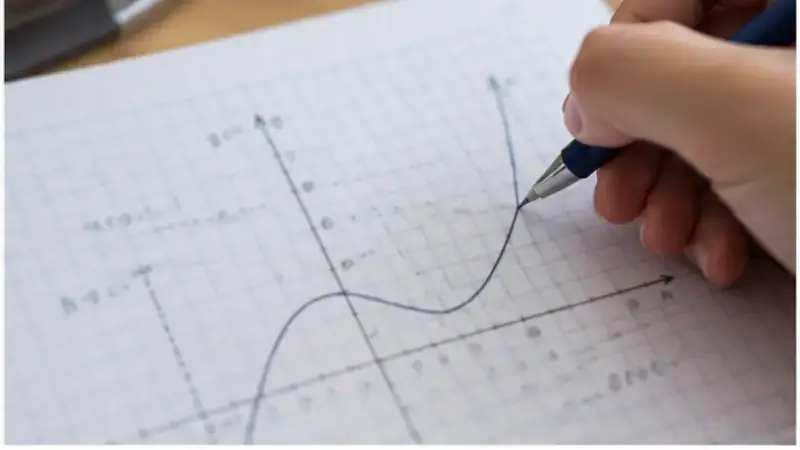
Questions can ask you to transform a relationship into a straight-line graph to determine constants. Choose the variables or powers that make the model linear, then identify the gradient and intercept from the transformed equation. State which graph axes correspond to the transformed variables. A graphing question tests the connection between algebra and representation, not only the ability to draw a line.
For quadratic graphs and intersections, connect roots with x-intercepts and the discriminant with the number of real intersections. A sketch can help interpret a result, but label axes, intercepts and turning points when they are relevant. If the question asks for a maximum or minimum in context, explain what the value represents rather than leaving the answer as an unexplained coordinate.
Differentiation: rules to know how to use
The syllabus includes derivatives of xⁿ for rational n, sin x, cos x, tan x, eˣ and ln x, with constant multiples, sums and differences. It also includes product, quotient and chain rules. The official mathematical formulae page does not list every differentiation rule as a printed formula in its short mathematical formulae section, so learn the rules your course requires and practise identifying which one applies.
The power rule turns xⁿ into nxⁿ⁻¹. For a constant multiple, keep the multiplier; for a sum or difference, differentiate each term. The chain rule applies when one function is inside another. Differentiate the outer function while leaving the inner expression in place, then multiply by the derivative of the inner expression. A practical check is to mark the inner function with brackets before differentiating.
The product rule applies to two factors that both depend on x; the quotient rule handles one function divided by another. Do not multiply the derivatives together or divide the derivatives. Write the whole rule first, substitute each function and its derivative, then simplify. When a product can be expanded easily, compare the expanded approach with the product rule as a check.
Stationary points occur when the first derivative is zero or undefined, subject to the function and interval. The second derivative can help distinguish local maxima and minima: a positive second derivative indicates a local minimum at a stationary point, while a negative value indicates a local maximum. If the second derivative is zero, this test is inconclusive; use further reasoning or examine the sign of the first derivative.

Integration and area
Integration reverses differentiation for the standard functions in the syllabus, including xⁿ for rational n, sin x, cos x, sec²x and eˣ, with constant multiples, sums and differences. For an indefinite integral, include the constant of integration because many functions can share the same derivative. For a definite integral, substitute the upper and lower limits after finding an antiderivative.
The syllabus also includes integration of linear transformations such as (ax+b)ⁿ, sin(ax+b), cos(ax+b) and e^(ax+b). Check the coefficient of x inside the function: a missing factor can make the derivative of your answer fail a quick check. One reliable habit is to differentiate your antiderivative to see whether you recover the original integrand.
A definite integral represents signed area. The area above the x-axis contributes positively; a region below contributes negatively to the integral. If a question asks for geometric area below the axis, split the interval at the x-intercept and report the positive area. Label the curve and limits so that the setup matches the diagram.
In applications involving displacement, velocity and acceleration, distinguish the quantities and units. If v is the derivative of displacement s with respect to time, integration of velocity gives a change in displacement, and integration of acceleration gives a change in velocity. Apply initial conditions where provided. A numerical answer without units or contextual interpretation may not fully answer the question.
What the formula sheet does not do for you
A supplied formula cannot identify a useful substitution by itself. In a modelling question, translate the wording into variables and an equation before choosing a technique. In a proof, state why each algebraic or trigonometric step follows. In a maximum-minimum problem, define the quantity you are optimising, differentiate it, and check the domain and physical constraints.
Formula provision does not mean that all results are supplied or that you can ignore syllabus content. Some content is a method or concept rather than a single equation: interpreting a discriminant, completing the square, solving inequalities, choosing a trigonometric identity, using the chain rule, or explaining what an integral means. Treat each syllabus bullet as something to understand and apply, not as a promise that a matching line will appear on a page.
Do not build a revision strategy around rumours about which formulas are “always given” or “never tested.” Use the official 2026 syllabus, your school’s examination instructions and the specimen materials available for the relevant year. If you are sitting a future paper, revisit the newest syllabus rather than assuming 4049 content and exam instructions remain unchanged.

How to make a personal A-Math revision sheet
Make one page per strand or topic, not a single crowded page that is hard to scan. For each formula, write its meaning, conditions, a short example of when it is useful, and one common mistake. Use consistent notation. If the official sheet supplies a relationship, mark it “provided in 2026 syllabus” and practise recognising it quickly; mark a technique you must recall or execute separately.
Keep the formula text accurate. Use brackets around negative values, write exponents clearly and distinguish sin⁻¹x from 1/sin x. These two expressions mean different things: inverse sine returns an angle, while the reciprocal is cosec x. Similarly, ln x and log₁₀x are different logarithms. A good formula sheet prevents ambiguity instead of compressing every line until the symbols become unreadable.
Build a “trigger” column: discriminant for roots or tangency, completing the square for vertex or centre-radius form, product rule for a product of functions, chain rule for a composite function, and triangle area formula for two sides with the included angle. The trigger is a clue, not a rigid rule. Some problems allow more than one method; compare them for clarity and risk of error.
End each page with a check list. Did I write the equation in standard form? Did I preserve the sign? Did I include the constant of integration? Did I consider all solutions in the requested interval? Did I round only when appropriate? Small prompts like these can be more valuable than adding another page of formulae.
A-Math formula sheet study plan for the final weeks
Start by marking every 4049 syllabus topic as secure, developing or not yet studied. Allocate practice to the developing and unfamiliar topics, while returning briefly to secure ones so that they stay fluent. Alternate strands across study sessions: algebra one day, trigonometry the next, then calculus. Mixed practice teaches you to decide which method a question requires.
Use a three-pass routine. First, attempt a question without looking at notes. Second, check the syllabus or your personal formula map and correct the method. Third, solve a similar question later without help. If you only reread an example solution, it can feel familiar without showing that you can reproduce the reasoning independently.
Keep an error log with a short label: wrong standard form, sign error, wrong angle mode, omitted solution, missing constant, premature rounding, or incomplete working. Add the corrected step, not only the final answer. Review the log weekly and solve fresh questions targeting the most frequent two errors.
Before a timed practice paper, prepare your approved calculator and learn its functions, but follow the current SEAB requirements about approved models and permitted use. During the paper, scan the marks and time, show essential working, and avoid spending too long on one difficult part. Return to unfinished parts after securing marks elsewhere.

Common A-Math formula mistakes
- Substituting into the quadratic formula too early: rearrange into ax² + bx + c = 0 first.
- Dropping a negative sign: bracket negative coefficients before squaring or multiplying.
- Using the wrong angle mode: check whether the question uses degrees or radians.
- Forgetting the opposite-side pairing: side a belongs opposite angle A.
- Stopping at the principal trigonometric value: check all solutions within the stated interval.
- Confusing a coefficient with a full binomial term: simplify the x power and numerical factor separately.
- Applying a derivative rule to the wrong structure: identify whether the function is a sum, product, quotient or composition.
- Forgetting the integration constant: include + C for an indefinite integral.
- Treating signed integral as total area: split regions that lie below the x-axis.
- Rounding intermediate values too soon: keep precision until the final line unless directed otherwise.
- Using an answer without working: show the steps needed to communicate the method.
Frequently asked questions
Is there an official A-Math formula sheet for Singapore O-Level?
The 2026 SEAB syllabus says relevant mathematical formulae will be provided and includes a mathematical formulae section. Use that official 4049 document for the examination year rather than relying on an unofficial list.
What formulas are provided for 2026 Additional Mathematics?
The official formula section includes the quadratic formula, binomial expansion, selected trigonometric identities and angle formulas, and sine-rule, cosine-rule and triangle-area relationships. Check the PDF for the exact notation and full presentation.
Do I need to memorise every formula in A-Math?
You should know the syllabus techniques and understand how to use relevant supplied formulae. Some methods, interpretations and derivative or integration rules require practice even when they are not printed in the short formula list.
Can I bring my own formula sheet into the examination?
A personal revision page is a study aid. Do not assume it is allowed in the examination hall. Follow SEAB’s current examination instructions and your school’s guidance.
What is the A-Math syllabus code?
The 2026 Singapore-Cambridge O-Level Additional Mathematics syllabus is 4049. Always verify the code and year for your own examination.
How many papers are there for 2026 O-Level A-Math?
The 4049 syllabus describes two papers, each lasting 2 hours 15 minutes and carrying 90 marks, with each paper weighted at 50%.
Are calculators allowed in A-Math?
The 2026 syllabus states that an approved calculator may be used in both papers. Check SEAB’s current approved-calculator rules and your examination instructions.
How should I round A-Math answers?
The 2026 syllabus generally specifies three significant figures for non-exact numerical answers and one decimal place for angles in degrees unless the question states otherwise. Keep extra precision in intermediate steps.
Does the formula sheet replace showing working?
No. The syllabus warns that omission of essential working can result in loss of marks. Write enough steps for the method to be clear.
What is the best way to revise A-Math formulas?
Practise retrieval and application: attempt questions without notes, check the relevant formula and conditions, then solve a similar question again later. Keep a short error log to target recurring mistakes.
Conclusion
A useful A-Math formula sheet is a map for choosing and applying ideas, not a shortcut around understanding. For Singapore’s 2026 O-Level syllabus 4049, relevant mathematical formulae are provided, and the official document names key algebra, trigonometry and triangle results. Students still need to master the syllabus techniques, show essential working, interpret answers and use the stated accuracy. Build your own revision pages around meaning, conditions, examples and common errors, then practise mixed questions until you can select a method without relying on a prompt.
Sources
- SEAB: 2026 O-Level syllabuses for school candidates
- SEAB and Cambridge: 2026 Additional Mathematics syllabus 4049 (PDF)
- SEAB: O-Level resources for school candidates
- SEAB: examination services and candidate resources
- Singapore Examinations and Assessment Board